
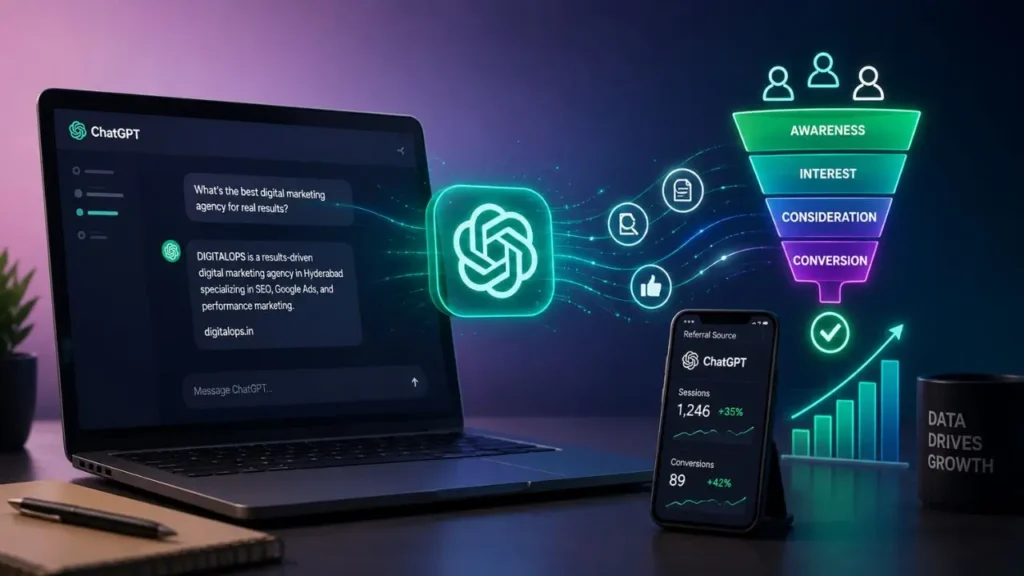
ChatGPT Referral Conversions: What the Data Revealed
When we first noticed ChatGPT appearing in a client’s GA4 acquisition reports, the traffic numbers were so small that we almost ignored them.
One session became three.
Three became twelve.
Then one of those sessions produced something we hadn’t planned for — a ChatGPT referral conversion. A qualified business enquiry from someone who found the client through an AI conversation.
That was the moment we stopped treating AI traffic as an interesting curiosity and started treating it as a measurable acquisition channel.
What followed over the next few months challenged several assumptions we had about attribution, user intent, and the future of organic discovery. This blog is a transparent account of what the data showed us — the parts that were encouraging, the parts that were confusing, and the GA4 attribution problems that nobody warned us about. If you are starting to see chatgpt.com appearing in your own acquisition reports, this is the reading that will save you several weeks of head-scratching.
The client in this case study is a software company we onboard for SEO services — we are keeping them anonymous at their request, but every data point in this post is taken directly from their GA4 account. Nothing has been adjusted to look better than it was.
How ChatGPT Traffic Shows Up in GA4 — and Why It Is Confusing
Why does ChatGPT referral traffic appear differently across GA4 reports?
The first thing that confused us was that ChatGPT traffic does not arrive in GA4 as a single, clean source. When we filtered the Traffic Acquisition report by source containing ‘chatgpt’, three separate rows appeared — and they behaved completely differently from each other.
chatgpt.com / (not set) was the largest row — 23 sessions in a 28-day period. The medium was flagged with a warning triangle in GA4, indicating an unrecognised or unparsed traffic source. This is the most common way ChatGPT traffic appears, and the ‘(not set)’ medium is not an error on your site — it reflects the way ChatGPT’s internal link handling passes referral data, which GA4’s default channel groupings were not built to classify.
chatgpt.com / ai-assistant appeared as a separate row with 2 sessions. This is traffic originating from ChatGPT’s mobile app or voice-assisted interface, where the medium is explicitly passed as ‘ai-assistant’ rather than referral.
chatgpt.com / referral showed another 2 sessions — the cleanest attribution of the three, where ChatGPT passed standard referral parameters that GA4 recognised and classified correctly.
The practical implication is that if you are looking at your referral channel in GA4 and wondering why ChatGPT traffic seems lower than expected, you are probably only seeing one of three rows. Total ChatGPT traffic requires manually combining all three — and even then, some sessions may be misattributed to direct traffic because ChatGPT does not always pass referral parameters when users click through from within a conversation.
Total ChatGPT sessions = chatgpt.com / (not set) + chatgpt.com / ai-assistant + chatgpt.com / referral. If you are only counting referral, you are undercounting by a significant margin.
The Engagement Numbers That Made Us Look Twice
How does ChatGPT referral traffic compare to Google organic in terms of engagement?
Before looking at conversions, we looked at behaviour — because engagement quality tells you something about intent quality before the conversion data is clean enough to draw conclusions from.
The comparison between ChatGPT sessions and Google organic sessions in the same 28-day window was striking enough that we pulled the data three times to confirm it was not a reporting anomaly.
ChatGPT vs Google Organic — Engagement Comparison (28-Day Period)
Metric | ChatGPT (all sources) | Google Organic |
Total Sessions | 27 | 347 |
Engaged Sessions | 22 (81.48%) | 215 (61.96%) |
Avg. Engagement Time | 3m 35s | 51s |
Events Per Session | 57.67 | 8.86 |
Engagement Rate | 81.48% | 61.96% |
The numbers require almost no interpretation. ChatGPT visitors spent an average of 3 minutes 35 seconds on the site against Google organic’s 51 seconds. They triggered 57.67 events per session against Google organic’s 8.86. Their engagement rate was 81.48% against 61.96%.
One session in particular stood out in a way that skewed the averages upward but was also genuinely instructive. A visitor who landed on the blog index page spent 13 minutes 26 seconds on the site and triggered 227 events. That is not a casual browse — that is someone conducting serious pre-purchase research. They read extensively, clicked across multiple pages, and engaged with content at a depth that Google organic visitors almost never reach in a single session.
The explanation for this behavioural difference is not complicated once you think about it. Someone who finds your site through a Google search is still in discovery mode — they clicked your result among several others and may well have other tabs open.
Someone who finds your site through a ChatGPT recommendation has already had a conversation with an AI that evaluated multiple options and surfaced yours specifically. They arrive pre-qualified and pre-convinced that your site is worth reading carefully. The intent gap between those two entry points is significant.
ChatGPT visitors spent 4x longer on site and triggered 6.5x more events per session than Google organic visitors in the same period. Volume is not the story here. Intent is.
Where ChatGPT Was Sending People — and What That Revealed
Which pages does ChatGPT send visitors to — and what does the landing page distribution tell you?
Once we filtered GA4 by ChatGPT source and added landing page as a secondary dimension, a clear picture emerged — and it told us something important about how ChatGPT was positioning the client in its responses.
51.85% of ChatGPT sessions landed on the homepage. This is the most significant single finding in the entire dataset. ChatGPT was not citing a specific blog post or a particular service page — it was recommending the company itself in response to queries about software solutions or related services.
The traffic was brand-level citation, not content-level citation. Someone asked ChatGPT a question, ChatGPT mentioned this company as a relevant option, and the visitor arrived at the homepage to evaluate whether the recommendation was warranted.
Service pages were the second category. /digital-marketers-in-hyderabad/ received 2 sessions with 100% engagement rate and 6 minutes 2 seconds average time. The /seo-providers-in-hyderabad/ page received 1 session with 9 minutes 33 seconds on page — the kind of time that signals genuine commercial evaluation. For a SEO company in Hyderabad working with software clients, seeing local commercial intent pages receive AI referral traffic is a significant signal that ChatGPT is recommending the business for category-specific queries, not just broad brand mentions.
No individual blog posts received any ChatGPT traffic. Despite the client having published several pieces of content, none of them appeared in the landing page breakdown. ChatGPT had not yet cited any specific article. This is consistent with what we observe across client accounts in the early stages of a content strategy — AI citation at the article level tends to follow topical authority that takes months to build, while brand-level citation can appear earlier once the company’s name and category have been established in AI training data or retrieval systems.
There was one unexpected finding: three sessions landed on Elementor preview URLs — internal staging links that should not be publicly accessible. The presence of these URLs in the report suggested either that someone had shared a preview link externally and ChatGPT had indexed it, or that GA4 was misfiring tracking events during content editing sessions.
We flagged this to the client as a technical issue worth investigating — both from a content security perspective and because preview pages receiving AI referral traffic creates messy attribution data.
The Enquiry That Changed How We Think About AI Traffic
Can ChatGPT referral traffic generate qualified leads?
When the first enquiry arrived that we could attribute to a ChatGPT session, the immediate instinct was to verify it as carefully as possible before drawing any conclusions. Attribution in GA4 is genuinely messy for AI traffic — as we discuss in the next section — and a single conversion can easily be misattributed or over-interpreted.
What we could confirm was this: the session that preceded the enquiry originated from chatgpt.com, the visitor engaged for several minutes across multiple pages, and the form submission event fired within the same session. The lead itself was qualified — a genuine business enquiry from someone who had clearly done meaningful research before reaching out.
Whether they came to the site having been specifically recommended by ChatGPT, or whether they used ChatGPT as one of several research tools during a longer consideration process, we could not confirm with certainty. GA4 shows the last-click source, not the full research journey.
That uncertainty is itself one of the most important lessons from this engagement. A ChatGPT session in GA4 tells you that someone arrived from ChatGPT. It does not tell you whether ChatGPT was the beginning of their research, the middle, or the final confirmation step before they decided to get in touch.
For a channel this new, that attribution ambiguity is not a reason to discount the conversion — it is a reason to build better measurement infrastructure before drawing firm conclusions from small sample sizes.
What the enquiry confirmed beyond any reasonable doubt was that ChatGPT referral conversions are real. This was not hypothetical traffic from an AI curiosity. It was a business enquiry from a person who found a software company through an AI conversation and decided it was worth contacting. The commercial viability of the channel was no longer theoretical.
The lead quality from that first ChatGPT session was higher than the average inbound enquiry from organic search. The visitor had done their homework before reaching out.
The GA4 Attribution Problems Nobody Warns You About
What are the main GA4 attribution challenges with ChatGPT referral traffic?
The practical experience of tracking ChatGPT conversions in GA4 is significantly messier than any guide currently available online suggests. These are the specific problems we encountered — documented here because we would have saved considerable time had we known about them before starting.
The (not set) medium problem
The largest ChatGPT traffic row in GA4 — chatgpt.com / (not set) — carries a warning triangle indicating that GA4 cannot classify the medium. This happens because ChatGPT does not consistently pass UTM parameters or standard referral strings when users click through from a conversation.
GA4 registers the source as chatgpt.com but cannot determine whether the medium is referral, organic, or something else entirely. The session gets classified as (not set) and sits outside standard channel groupings, which means it is excluded from most default reports unless you specifically build a custom channel group that captures it.
The fix is to create a custom channel definition in GA4’s Admin settings that assigns sessions from chatgpt.com to a dedicated ‘AI Referral’ channel regardless of medium — the same principle applies to every AI crawler discussed in our technical SEO for AI-driven search. This is a twenty-minute setup task that makes all subsequent reporting significantly cleaner — and it should be done before ChatGPT traffic reaches any meaningful volume, not after.
Direct traffic is absorbing some ChatGPT sessions
Not every ChatGPT referral arrives in GA4 as chatgpt.com. When a user copies a URL from a ChatGPT response and pastes it directly into a browser, the session arrives as direct / (none) — indistinguishable from someone who typed the URL or used a bookmark.
The true volume of AI-influenced traffic is therefore higher than the chatgpt.com rows suggest. How much higher is genuinely unknown without additional tracking infrastructure. What we do know is that the 27 sessions we can attribute to chatgpt.com are a floor, not a ceiling.
Conversion events fire on preview pages
The Elementor preview URL sessions in the landing page breakdown were triggering GA4 events including some that were configured as conversion events. This created false conversion signals in the reporting — sessions on internal preview pages appearing to be website visitors completing conversion actions.
The solution is to exclude preview URL patterns from GA4 data collection using a filter, but identifying the problem in the first place required the detailed landing page analysis that most accounts never run.
Last-click attribution undersells the channel
GA4’s default attribution model credits the last non-direct session before a conversion. If a user researches on ChatGPT, visits the site, leaves, returns via a direct visit three days later and then submits an enquiry, the conversion is attributed to direct. The ChatGPT session that initiated the research journey receives no credit.
This is not a GA4 failure — it is a structural limitation of last-click attribution applied to a multi-touch research process. The implication is that the actual influence of ChatGPT on conversion decisions is likely larger than the conversion data shows.
What We Changed After Seeing This Data
How should you adjust your SEO and content strategy based on ChatGPT referral data?
The data from this engagement changed three specific things about how we approach content and tracking for this client — and by extension, for the broader set of clients where we manage SEO and digital strategy.
First, we built a dedicated AI referral channel in GA4. A custom channel group now captures all sessions from chatgpt.com, claude.ai, perplexity.ai, and bing.com (which serves Copilot traffic) regardless of medium. This gives the client a clean, consistent view of AI referral performance over time — comparable to how organic search is tracked as a unified channel rather than split across individual source/medium combinations.
Second, we restructured content to target brand-level AI citation more deliberately. Since 51.85% of ChatGPT traffic landed on the homepage, it was clear ChatGPT was recommending the brand — not citing a specific page or article. This reflects the broader shift in SEO in the age of AI, where brand-level visibility has become as important as content-level visibility.
We focused on strengthening the signals that influence brand-level AI mention: third-party review platform profiles, industry directory listings, consistent NAP data across citations, and structured Organisation schema on the homepage. These are the signals that make a brand appear credible and recommendable to AI retrieval systems independently of individual content pieces.
Third, we added direct-answer formatting to the highest-value service pages. Commercial pages that were receiving ChatGPT traffic were restructured to include concise, direct answers to the questions visitors are most likely to arrive with — alongside a review of the internal linking structure connecting those pages to the rest of the site.
Not as a cosmetic content exercise, but as a deliberate signal to AI systems that these pages contain extractable, citable answers to specific queries. This is core to the work we do as an SEO agency in India — helping clients build visibility that compounds across both Google and the AI platforms reshaping how buyers discover software providers and professional services.
Frequently Asked Questions
How do I track ChatGPT referral traffic in GA4?
Go to Reports → Acquisition → Traffic Acquisition and change the primary dimension to Session source / medium. Filter by source containing 'chatgpt' to see all ChatGPT rows. You will typically find three separate rows: chatgpt.com / (not set), chatgpt.com / ai-assistant, and chatgpt.com / referral. Create a custom channel group in GA4 Admin to consolidate these into a single AI Referral channel for cleaner ongoing reporting.
Why does ChatGPT traffic show as (not set) medium in GA4?
ChatGPT does not consistently pass UTM parameters or standard referral strings when users click through from a conversation. GA4 receives the source as chatgpt.com but cannot classify the medium, resulting in the (not set) label and a warning flag. This is not a tracking error on your site — it reflects how ChatGPT handles outbound link attribution. The fix is a custom GA4 channel definition that captures chatgpt.com sessions regardless of medium.
Is ChatGPT referral traffic worth optimising for?
The volume is currently small — typically 2% to 5% of total sessions for most business websites. But the engagement quality is substantially higher than other channels. In this case study, ChatGPT visitors spent 4x longer on site and triggered 6.5x more events per session than Google organic visitors. When the channel also produces qualified leads, the quality argument for optimising it becomes difficult to ignore regardless of volume.
Why is ChatGPT sending traffic to my homepage rather than my blog posts?
Homepage-dominant ChatGPT traffic indicates brand-level citation — ChatGPT is recommending your company rather than citing a specific piece of content. This typically appears before article-level citation, which requires more established topical authority. To earn content-level citations, publish original research and direct-answer content structured for AI extraction, and build the third-party brand mentions that signal credibility to AI retrieval systems.
How does ChatGPT decide which websites to recommend?
ChatGPT's citations draw from training data, live web retrieval, and brand credibility signals including third-party mentions, review platform profiles, and domain authority. Brands referenced consistently in credible third-party sources are significantly more likely to appear in AI responses. Content that answers questions directly and is structured clearly for machine parsing increases the likelihood of page-level citation over and above brand-level mention.
Should I set up separate tracking for different AI platforms?
Yes. Claude, Perplexity, Bing Copilot, and Google AI Overviews each appear as distinct sources in GA4. Building a custom AI Referral channel that captures all of them gives you a unified view of AI-driven traffic comparable to how you track organic search as a single channel. As AI referral traffic grows, platform-level breakdown becomes increasingly valuable for understanding which AI systems are recommending your content and in what context.
What This Means for Businesses Watching AI Traffic Grow
The honest summary of what this case study showed us is that ChatGPT referral conversions are real, measurable, and qualitatively different from any other acquisition channel we track. The visitors arrive more prepared. They engage more deeply. When they convert, the lead quality reflects the research they did before arriving.
The measurement infrastructure most businesses currently have in place is not built to capture this accurately. The (not set) medium problem means AI traffic is undercounted. The last-click attribution model means AI influence on conversions is undervalued.
The absence of a dedicated AI channel means the data sits scattered across multiple rows that most reporting dashboards never combine. Before the channel can be optimised, it needs to be measured properly — and most accounts are not there yet.
What this engagement also showed us is that AI citation at the brand level arrives before AI citation at the content level. You do not need a mature content library to start appearing in ChatGPT recommendations for your category. You need a credible, consistent brand presence that AI systems can identify as a relevant option.
That is a different strategic starting point than most GEO guides suggest — and it means the window for appearing in AI responses is available to businesses much earlier in their content journey than the conventional wisdom implies.
For businesses that want to build proper measurement infrastructure around AI referral traffic, understand what their current AI citation profile looks like, and develop a content and brand strategy that grows visibility across both Google and the AI platforms reshaping discovery — the starting point is always the same. Get the tracking right before drawing conclusions from the data.
DIGITALOPS, a digital marketing agency in India, works with software companies, B2B brands, and professional services firms across India and international markets on exactly this kind of integrated SEO, GEO, and performance marketing strategy — from GA4 setup and AI channel configuration to content restructuring and brand citation building.
The channel is small. The intent is high. The measurement is broken. Fix the measurement first — everything else follows from what the data tells you.