Technical SEO for AI-Driven Search: Why the Foundation Has Changed
Technical SEO for AI-driven search is no longer just about helping Googlebot crawl your website. Today, the same technical decisions that influence your visibility in Google Search also affect whether AI platforms can discover, understand, and reference your content.
If your technical foundation is weak, your pages may never become part of the answers generated by platforms like ChatGPT, Perplexity, Gemini, or Microsoft Copilot. Each of these systems processes information differently, but they all depend on websites that are easy to crawl, interpret, and trust.
These are not separate optimization challenges. They share the same technical foundation. And as AI-driven search becomes more influential, that foundation is more important than ever.
Google still processes an estimated 16.4 billion searches every day. ChatGPT handles around 2.5 billion prompts daily. Meanwhile, Google AI Overviews now appear in approximately 25.11% of Google searches, up from 13.14% in March 2025. Perplexity has also become a preferred research tool among many professionals, with recent studies showing particularly strong adoption among senior leaders and high-income knowledge workers.
These are no longer niche platforms—they are where potential customers research solutions, compare providers, and make buying decisions. As digital visibility across search and AI platforms becomes increasingly important, your website’s technical foundation needs to support how these systems discover and interpret your content. Without that foundation, you’re missing valuable opportunities to be found.
This blog covers the specific technical requirements that determine AI visibility across every major discovery system — what they share, where they differ, and how to build a foundation that serves all of them simultaneously. The analysis draws on current research and on the technical SEO work carried out by DIGITALOPS across client sites in India and international markets.
How Each AI System Discovers and Evaluates Your Content
How do Google AI Overviews, ChatGPT, Perplexity, and Gemini decide what content to cite?
Before addressing technical fixes, it is worth understanding how each system actually retrieves and evaluates content — because the mechanisms differ in ways that affect which technical decisions matter most for each platform.
Google AI Overviews and AI Mode
Google’s AI Overviews primarily draw from pages that are already indexed and eligible to appear in standard Google Search results. According to Google, there are no additional technical requirements beyond ensuring your content can be crawled, indexed, and understood through established SEO best practices.
This is one of the most important takeaways for businesses investing in technical SEO for AI-driven search: improving your website’s technical foundation for Google also strengthens its eligibility for AI Overviews. These are not separate optimisation efforts—they share the same underlying technical requirements.
Supporting this, research from Ahrefs found that 76.1% of URLs cited in AI Overviews already rank in Google’s top 10 search results, highlighting the strong relationship between traditional search visibility and inclusion in Google’s AI-generated responses.
ChatGPT
ChatGPT can answer questions in two ways, depending on the user’s query. For topics requiring current information, it may perform a live web search to retrieve recent content. For broader or less time-sensitive questions, it relies on the knowledge embedded in the model, which is supplemented by publicly available information it has been trained to understand. The exact proportion of queries that trigger live web search varies and may change as OpenAI continues to evolve its systems.
When ChatGPT performs a live web search, standard technical SEO principles still apply. Your website must be crawlable, indexable, and accessible to the crawlers that support OpenAI’s retrieval systems. Reviewing your robots.txt configuration to ensure relevant OpenAI crawlers are not unintentionally blocked is an important first step.
However, technical SEO is only part of the equation. For broader brand recognition, ChatGPT also draws on signals that extend beyond your website. Consistent mentions across authoritative publications, reputable industry websites, community discussions, and trusted reference sources help strengthen your brand’s digital footprint. Research from Profound (June 2025) found that Wikipedia accounted for 7.8% of ChatGPT citations, followed by Reddit (1.8%) and Forbes (1.1%), illustrating the importance of establishing authority beyond your own domain.
Perplexity
Perplexity is citation-first by design. Unlike traditional search engines, it prominently displays the sources behind every response, making it one of the easiest AI platforms for brands to monitor and measure referral visibility. Its crawler, PerplexityBot, actively discovers web content and tends to favour pages that are recent, well-structured, and supported by credible sources.
From a technical SEO perspective, websites are more likely to perform well when content is easily crawlable, loads without unnecessary rendering barriers, uses structured data to help machines interpret page content, and demonstrates clear freshness through regular updates. While no single technical factor guarantees inclusion, these elements make it easier for Perplexity to discover, understand, and reference your content.
Perplexity also attracts a highly professional audience. Recent research indicates particularly strong adoption among senior decision-makers and high-income knowledge workers, making it an increasingly valuable visibility channel for B2B companies, software providers, agencies, and professional services firms.
Gemini and Copilot
Google Gemini operates within Google’s search ecosystem and relies on many of the same underlying signals as Google Search and AI Overviews. Pages that are crawlable, indexed, technically sound, and supported by strong E-E-A-T signals are generally better positioned to appear across Google’s AI-powered experiences.
Microsoft Copilot, on the other hand, is closely integrated with Microsoft’s search ecosystem and draws heavily from Bing’s index for web-based responses. That makes Bing crawlability an important, but often overlooked, part of technical SEO. Many websites focus exclusively on Googlebot while never verifying whether Bingbot can efficiently crawl and index their content. As a result, they may limit their visibility across Bing Search and Microsoft’s AI experiences.
Fortunately, addressing this gap is straightforward. Verifying your website in Bing Webmaster Tools, submitting an XML sitemap, reviewing crawl reports, and ensuring Bingbot isn’t unintentionally blocked can significantly improve discoverability within Microsoft’s search ecosystem.
| Platform | Primary Discovery Method | Key Technical SEO Priorities |
|---|---|---|
| Google Search | Googlebot | Crawlability, indexation, Core Web Vitals, structured data |
| Google AI Overviews / Gemini | Google Search index | Strong technical SEO, E-E-A-T, structured content |
| ChatGPT | Live web retrieval (when used) + model knowledge | Crawlability for web retrieval, broader brand authority |
| Perplexity | PerplexityBot + citation-first retrieval | Structured data, freshness, fast loading, accessible content |
| Microsoft Copilot | Bing index | Bingbot access, XML sitemaps, Bing Webmaster Tools |
The Technical Foundation Every AI-Visible Site Needs
What technical SEO elements are most critical for AI search visibility?
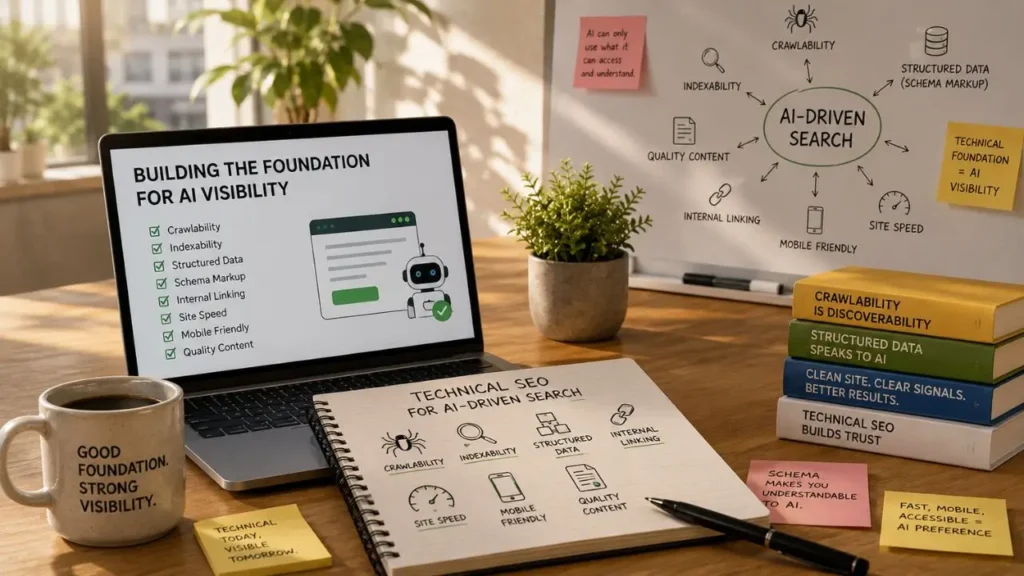
The technical requirements for AI visibility can be grouped into four layers, with each one forming the foundation for the next. A website with well-implemented structured data but poor crawlability is unlikely to benefit fully from its schema.
Likewise, a fast-loading website with critical pages blocked by noindex directives is unlikely to appear consistently across search engines or AI-powered platforms. These layers should be addressed in sequence because weaknesses in one layer can limit the effectiveness of everything built on top of it.
Layer 1 — Crawlability: Can AI systems reach your content?
This is the most foundational requirement and one of the most commonly overlooked. For Google AI Overviews, standard Googlebot access is required, and most websites already have this covered. However, platforms such as ChatGPT and Perplexity rely on their own crawlers for live web retrieval, including OAI-SearchBot and PerplexityBot. These crawlers are blocked on a surprising number of websites—sometimes intentionally after broad robots.txt updates, and sometimes unintentionally due to CDN or server configuration changes.
The check takes only a few minutes. Open your robots.txt file and look for any Disallow rules that reference OAI-SearchBot, ChatGPT-User, PerplexityBot, or Bingbot. If these crawlers cannot access your content, your opportunities to appear in the AI experiences that rely on them may be significantly reduced, regardless of content quality. For Microsoft Copilot, also verify that Bingbot can crawl your website. Many organizations have historically focused almost exclusively on Googlebot because Bing generated relatively little organic traffic. As Microsoft’s AI ecosystem continues to grow, ensuring Bingbot access has become an increasingly important part of technical SEO.
Layer 2 — Indexation: Are your key pages actually in the index?
A page that cannot be indexed cannot be cited — and indexation failures are one of the most common reasons SEO rankings drop suddenly. The most common indexation failures affecting AI visibility are noindex tags applied to pages that should be publicly accessible, canonical tags pointing high-value pages to less authoritative URLs, and JavaScript-rendered content that is difficult for AI crawlers to process efficiently.
JavaScript rendering is a particular consideration for AI visibility. While Googlebot has become increasingly capable of rendering JavaScript, many AI crawlers are believed to rely primarily on the raw HTML they retrieve rather than fully rendering pages like a modern browser. If your most important content is generated dynamically and is missing from the initial HTML response, AI systems may receive an incomplete representation of the page.
Server-side rendering (SSR) or static site generation (SSG) helps ensure that critical content is immediately available in the HTML, making it easier for both search engines and AI systems to crawl, understand, and reference your pages. For websites built on modern JavaScript frameworks, this can be one of the most impactful technical improvements for long-term AI visibility.
Layer 3 — Structured Data: Are you giving machines explicit signals?
Structured data — implemented via JSON-LD using Schema.org vocabulary — tells AI systems unambiguously what a page contains, who wrote it, what organisation it belongs to, and what questions it answers. It is the difference between a machine inferring what your page is about from the prose and a machine being told directly in a format it can parse without ambiguity.
The schema types most directly relevant to AI citation eligibility are:
- Article schema with author name, credentials, and dateModified — signals E-E-A-T and content freshness to both Google and AI retrieval systems
- FAQPage schema — makes question-and-answer content explicitly machine-readable, helping search engines and AI systems interpret page structure more effectively.
- Organisation schema — establishes the entity identity of your business, connecting your website to your brand’s broader online presence across third-party sources
- BreadcrumbList schema — helps AI systems understand site hierarchy and content relationships, improving topical authority signals
Recent research also suggests that schema markup alone does not significantly increase the likelihood of appearing in AI Overviews or ChatGPT citations when implemented in isolation. Schema works as part of a complete technical foundation — it amplifies the signals from good content and clean crawlability, but it does not compensate for missing those prerequisites. Implement it as part of the foundation, not as a standalone fix.
Layer 4 — Performance: Does the page load reliably for AI crawlers?
Page performance influences AI visibility in much the same way it influences traditional search. Fast, stable websites are generally easier for automated systems to crawl, process, and revisit than pages that are slow, unstable, or frequently return errors. While AI platforms have not published specific performance requirements, reliable page delivery helps ensure that both search engines and AI systems can consistently access and interpret your content.
The Core Web Vitals benchmarks established by Google — LCP under 2.5 seconds, INP under 200 milliseconds, and CLS under 0.1 — remain valuable performance targets. Although these metrics were introduced to improve user experience rather than AI crawler behaviour, websites that meet them typically have stronger technical foundations, making them easier for both users and automated systems to access. Performance alone will not earn AI citations, but it supports the broader technical reliability that AI-driven search increasingly depends on.
Technical Foundation Checklist for AI Search Visibility
Technical Requirement | Google / AI Overviews | ChatGPT / Perplexity | Copilot |
Googlebot not blocked in robots.txt | Critical | Not applicable | Not applicable |
OAI-SearchBot / PerplexityBot not blocked | Not applicable | Critical | Not applicable |
Bingbot not blocked in robots.txt | Not applicable | Indirect | Critical |
Key pages indexed — no noindex errors | Critical | Critical | Critical |
Content in raw HTML — not JS-only | Important | Critical | Important |
Article + Author schema implemented | Important | Important | Important |
FAQPage schema on Q&A content | Important | Important | Important |
Organisation schema on homepage | Important | Important | Important |
Core Web Vitals passing (LCP/INP/CLS) | Critical | Important | Important |
Bing sitemap submitted | Not applicable | Not applicable | Important |
Content Structure: The Technical Layer Most Sites Miss
How should content be structured technically to maximise AI citation across all platforms?
Technical SEO and content structure are often treated as separate disciplines. For AI visibility, they are closely interconnected. The way content is structured on a page—its heading hierarchy, paragraph length, answer placement, and internal linking architecture—provides important structural signals that help search engines and AI systems understand, navigate, and interpret your content. Well-structured pages are also easier to extract, summarise, and reference when generating AI-powered responses.
The direct-answer requirement
Every major AI discovery platform — including Google AI Overviews, ChatGPT, Perplexity, and Gemini — is designed to answer questions directly. Content is generally easier to reference when the answer appears immediately beneath a descriptive heading, with supporting detail expanding on the topic afterward — this is the structural principle behind effective content marketing for SEO. This is more than a stylistic preference — it aligns with how modern search engines and AI systems retrieve, interpret, and present information.
Rather than treating every paragraph on a page equally, AI systems often identify the section that most directly answers the user’s query. If the key answer is buried beneath several paragraphs of background information, it may be harder to extract and reference. When the answer appears within the opening sentences of a clearly structured section, followed by supporting context and examples, it is easier for both human readers and AI systems to understand.
Heading hierarchy as machine navigation
H1, H2, and H3 headings are more than visual formatting choices—they provide structural signals that help search engines and AI systems understand how a page is organised and how different sections relate to one another. A page with a clear, logical heading hierarchy—one H1, multiple H2 sections, and supporting H3 subsections—creates a well-defined content structure that is easier to navigate and interpret. By contrast, using heading tags purely for visual styling rather than their intended structural purpose can make the page more difficult for both users and machines to understand.
A heading structure that works well for AI-driven search is one where H2 headings define the primary topics covered on the page, while H3 headings introduce specific, answerable questions or supporting subtopics within those sections. This creates a logical question-and-answer flow that is easier for AI systems to interpret and reference, even without applying FAQPage schema to every section.
Freshness signals — more important than most realise
AI systems, particularly those that retrieve live web content such as Perplexity and ChatGPT’s web search mode, often place greater value on content that is current, well-maintained, and demonstrably up to date. While freshness alone does not guarantee visibility, regularly updated content is more likely to remain relevant for topics that evolve quickly.
The dateModified property in Article schema provides search engines and AI systems with an explicit signal indicating when a page was last updated. This timestamp should reflect genuine content improvements rather than cosmetic edits. Updating it alongside meaningful changes—such as adding new statistics, refreshing examples, expanding explanations, or revising recommendations—provides a stronger and more credible freshness signal.
Industry guidance, including recommendations from amivisibleonai.com, suggests reviewing important pages regularly and refreshing them whenever significant new information becomes available. For many businesses, updating high-value pages every quarter with meaningful improvements and an accurate dateModified timestamp is a practical and sustainable maintenance strategy.
Internal linking as topical authority architecture
The internal linking structure of a website provides important contextual signals that help search engines understand how pages relate to one another. As AI systems increasingly rely on well-organised, crawlable content, those same relationships make it easier to interpret topical coverage and identify authoritative pages within a website.
A page that sits within a dense network of related internal links—with multiple relevant pages linking to it using descriptive anchor text—clearly demonstrates its importance within a topic area. By contrast, a page with no internal links pointing to it becomes an orphan, making it more difficult for both Google and AI-powered systems to discover, understand, and revisit consistently.
One of the most practical insights for modern SEO is that the internal linking strategy that strengthens Google’s understanding of topical authority also supports AI-driven search. Building logical topic clusters, using descriptive anchor text, and connecting related content benefit both traditional search engines and emerging AI discovery platforms.
The Off-Site Technical Layer: Third-Party Presence
Why does third-party presence matter for technical AI search visibility?
The foundation for AI visibility extends beyond your own website in ways that traditional technical SEO never fully addressed. For Google Search, off-site authority has historically been measured largely through backlinks. AI-powered search broadens that perspective by also considering consistent brand mentions and entity signals across trusted third-party sources.
Wikipedia remains one of the most frequently cited sources in ChatGPT, accounting for 7.8% of citations in Profound’s research. Reddit follows at 1.8%, while authoritative publishers and review platforms—including Forbes, G2, and Clutch—also appear regularly in AI-generated citations.
SE Ranking has likewise reported that businesses with established profiles on platforms such as G2 and Clutch are cited significantly more often than those without them. This illustrates an important shift: AI visibility is influenced not only by your website but also by how consistently your brand appears across trusted sources.
The practical implication is that AI SEO requires a parallel workstream focused on strengthening your brand’s digital presence. This includes maintaining a complete Google Business Profile, building profiles on relevant industry directories and review platforms, ensuring consistent NAP (Name, Address, Phone) information across citations — all foundational elements of a strong local SEO strategy. Where appropriate, establishing a Wikipedia presence that genuinely meets the platform’s notability guidelines adds an additional layer of brand authority.
These activities are best viewed as entity optimisation rather than traditional technical SEO. Together, they help search engines and AI systems build confidence in your brand’s identity and credibility beyond the information published on your own website.
AI System Citation Signals: What Each Platform Weights Most
Signal | Google AI Overviews | ChatGPT | Perplexity |
Traditional Google ranking | Strong correlation (76.1%) | Weak correlation | Moderate correlation |
Raw HTML content (no JS) | Important | Critical | Critical |
Structured data / schema | Important | Moderate | Moderate |
Content freshness | Important | Critical (live search) | Critical |
Third-party citations / Reddit / G2 | Moderate | Strong | Strong |
Direct-answer content structure | Strong | Strong | Strong |
E-E-A-T / author credentials | Critical | Important | Important |
Core Web Vitals | Critical ranking factor | Indirect — load reliability | Indirect — load reliability |
Build the Foundation — The Citations Follow
The most important conclusion from the research on technical SEO for AI-driven search is also the most reassuring one: the technical foundation that helps a website perform well in Google Search is largely the same foundation that improves its visibility across AI-powered discovery platforms such as ChatGPT, Perplexity, Gemini, and Copilot.
Clean crawlability, reliable indexation, structured data, server-side rendered content, and strong Core Web Vitals performance are not separate AI requirements layered on top of traditional SEO. They are established technical SEO best practices that continue to matter, while also supporting the needs of modern AI-driven search.
Where the work extends beyond traditional technical SEO is in two areas: content structure that makes information easier for AI systems to interpret and reference, and a strong off-site entity presence that reinforces brand authority through trusted third-party sources. Both require deliberate planning, but neither requires businesses to start from scratch if the underlying technical foundation is already in place.
The businesses most likely to build lasting AI visibility over the coming years will be those that strengthen their technical foundations systematically rather than chasing isolated optimisation tactics. If you’re looking to understand how your website performs across Google AI Overviews, ChatGPT, Perplexity, Gemini, and Microsoft Copilot, a comprehensive AI SEO audit can identify the technical improvements with the greatest potential impact.
At DIGITALOPS, an AI-powered digital marketing agency based in Hyderabad, India, we help businesses across India and international markets build these technical foundations as part of every AI SEO engagement.
AI citation is not a content problem. It is a technical access problem first, a structure problem second, and a credibility problem third. Fix them in that order.
Frequently Asked Questions
Does technical SEO for AI-driven search require a completely different approach to traditional SEO?
No — and Google has confirmed this explicitly. The technical requirements for Google AI Overviews are identical to standard Google indexation requirements. The additional work for ChatGPT and Perplexity visibility is primarily crawler access (ensuring OAI-SearchBot and PerplexityBot are not blocked) and content structure (direct-answer formatting and clean HTML). The overlap between traditional technical SEO and AI technical requirements is substantial.
Do I need to allow AI crawlers access to my site?
Yes, if you want to appear in live web search citations from ChatGPT, Perplexity, and similar systems. Check your robots.txt for Disallow rules covering OAI-SearchBot, ChatGPT-User, and PerplexityBot.
If any of these are blocked, those AI systems cannot retrieve your content for live query responses. Note that blocking these crawlers does not affect your Google ranking — it only affects AI citation from those specific platforms.
How important is schema markup for AI citation?
Useful as part of a complete technical foundation, but not a standalone fix. A 2026 study found schema markup alone produced no major uplift in AI citation when tested in isolation. Schema works by amplifying good content and clean crawlability — it helps AI systems parse and attribute your content more accurately when the other technical prerequisites are already in place. Implement Article, FAQ Page, and Organisation schema as standard, but do not expect schema alone to improve AI citation on a site with crawlability or indexation issues.
Why does Perplexity matter if my audience is in India?
Perplexity's user base skews heavily toward senior professionals — 30% are in leadership roles and 65% are in high-income white-collar professions. For B2B businesses, software companies, and professional services firms, this audience profile makes Perplexity citation disproportionately valuable relative to its overall traffic volume. India is also one of the fastest-growing markets for both ChatGPT and Perplexity, growing 200% year-on-year according to recent usage data.
How do I check if my site is being cited by ChatGPT or Perplexity?
The most direct method is to query each platform with questions your content should answer and observe whether your site is cited. For ongoing monitoring, tools like Profound, Amplitude AI Visibility, and SE Ranking's AI tracking features track citation frequency across ChatGPT, Perplexity, and Google AI Overviews. In GA4, monitor referral traffic from chatgpt.com, perplexity.ai, and claude.ai as a proxy for citation-driven visits — our ChatGPT referral conversions case study covers exactly how to set this up and what the data reveals. Bear in mind that some AI-referred traffic arrives as direct traffic due to attribution limitations.
Does JavaScript-rendered content hurt AI visibility?
Yes, significantly for ChatGPT and Perplexity. Unlike Googlebot, which renders JavaScript reasonably well, most AI crawlers retrieve raw HTML without executing JavaScript. If your key content — service descriptions, case studies, FAQ sections — only exists in the rendered DOM after JavaScript execution, AI crawlers see a sparse or empty page. Server-side rendering or static generation of content-heavy pages resolves this and is one of the highest-impact technical changes available for AI visibility on JavaScript-framework sites.