
Two Systems. Two Completely Different Definitions of Authority
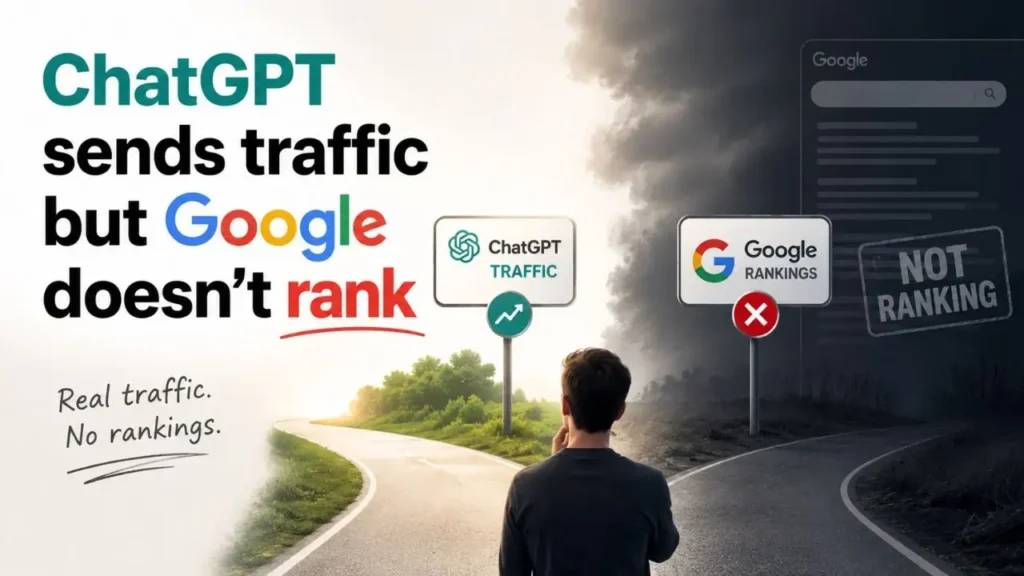
Something strange has been happening to a growing number of websites in 2026. ChatGPT sends traffic but Google doesn’t rank the same pages — and business owners are noticing it in their analytics. Referral visits are coming in from AI-generated answers, yet Google Search Console tells a completely different story. Organic impressions remain flat. Rankings stay unchanged. Google, apparently, has not noticed.
If this sounds familiar, you are not imagining it and you are not alone. The reality that ChatGPT sends traffic but Google doesn’t rank the same content has become one of the most discussed — and most misunderstood — phenomena in digital marketing this year.
Marketers are seeing it in their data, clients are asking about it in briefing calls, and the SEO industry is still working out what it actually means for strategy.
What follows is an honest attempt to explain why this gap exists, what it tells us about the diverging architectures of traditional search and generative AI, and what you should actually do about it if you are sitting in that strange position of being cited by ChatGPT but invisible on Google.
The analysis draws on some genuinely surprising recent data and on the work our team at DIGITALOPS, a performance marketing and SEO agency based in Hyderabad, has been doing with clients navigating exactly this situation.
Why Google and ChatGPT Are Not the Same Thing
The starting point for understanding this gap is accepting that Google and ChatGPT are not trying to do the same thing. They look superficially similar from the user’s perspective — you ask a question, you get an answer — but the systems underneath are built on fundamentally different logic, and they reward fundamentally different things.
Google’s algorithm has been refined over twenty-five years through numerous updates and refinements, as documented in the history of Google algorithm updates. It measures trust through a complex web of signals — backlinks from authoritative domains, user engagement patterns, content freshness, technical performance, E-E-A-T signals, and hundreds of other inputs that collectively tell Google whether a page has been validated by real humans over real time.
The result is a ranking system where authority is accumulated slowly, through sustained effort, and where a page that has spent years earning quality backlinks and user trust holds a structural advantage over newer content regardless of quality.
ChatGPT — and other large language models — ask a completely different question: does this page directly answer the question being asked, in a way a language model can parse and reproduce? There are no backlink graphs in that calculation. There is no domain age, no click-signal history, no dwell time measurement.
There is the text on the page, how clearly it answers the question, how well it is structured for machine parsing, and whether the source has a reputation for accuracy that has made it into the model’s training data or retrieval index.
A page that has been online for three months with zero backlinks but a crystal-clear, well-structured answer to a specific question can get cited by ChatGPT while a page-one Google result from an established domain gets ignored entirely.
This is not a bug. It is by design. And understanding it changes how you think about content strategy.
What the Data Actually Shows
The anecdotal observation that ChatGPT sends traffic but Google doesn’t rank the same pages has now been confirmed by several serious research efforts, and the numbers are striking enough to be worth looking at directly rather than summarising in vague terms.
A Search Atlas analysis of 18,377 matched queries found that ChatGPT’s median domain overlap with Google search results stayed around 10–15%. The model shared just 1,503 domains with Google, representing about 21% of its cited domains — and URL-level matches typically remained below 10%. In plain terms: for every ten pages ChatGPT cites on a given topic, roughly nine of them are not in Google’s top results for that same query.
Semrush’s research into LLM citations found something even more pointed: 89% of ChatGPT citations come from pages ranking at position 21 or lower in Google search. Not page two. Not page three. Position 21 and beyond — content that is effectively invisible to the vast majority of Google users.
Yet ChatGPT is citing it. The implication is that ChatGPT has no particular preference for pages that Google has decided are the most authoritative. It is running its own assessment.
Perhaps the most counterintuitive data point: 28% of ChatGPT’s most-cited pages have zero organic Google visibility. They do not rank for the query at all. They are not in the index for that term. Yet they are being surfaced inside AI-generated answers that millions of people are reading. If you needed a single statistic to justify treating AI optimisation as a distinct discipline from SEO, that is probably it.
On the traffic side, the picture is nuanced. ChatGPT referral traffic to websites grew 206% year on year comparing January 2025 to January 2026 — a pattern we tracked in detail in our ChatGPT referral conversions case study with a real client account, according to Semrush’s clickstream analysis of over a billion data points. But that growth is concentrated: the top ten domains capture over 30% of all ChatGPT referrals, with Google itself accounting for 21.6% of that total. For most websites, ChatGPT referral traffic remains meaningful but modest — averaging around 0.19% of total referral traffic compared to Google’s 42%, according to Ahrefs data published in mid-2025.
Taken together, the evidence helps explain why so many marketers are reporting that ChatGPT sends traffic but Google doesn’t rank the same content. The picture that emerges is one of two parallel visibility systems, growing in parallel, rewarding different things, and requiring different strategies to win in. The question is not which one to focus on. The question is how to build content that performs well in both.
Why ChatGPT Cites You When Google Doesn’t
If you are receiving ChatGPT referral traffic despite weak Google rankings, there are usually a handful of identifiable reasons. Understanding which one applies to your situation determines what you should do next.
Your content answers questions directly and structurally
One reason ChatGPT sends traffic but Google doesn’t rank the same page is that the two systems evaluate content very differently.
The single biggest factor in whether a large language model cites your content is whether your page directly and clearly answers the question a user is likely to ask, in language the model can extract and reproduce.
LLMs are essentially answer-retrieval systems. They are looking for pages that make the answer easy to find — clear subheadings that frame questions, concise opening paragraphs that give direct answers, structured information that can be parsed without ambiguity.
If your content does this well — even if it lacks the backlink authority that Google rewards — ChatGPT will find it useful. Google, meanwhile, may still be waiting for the domain authority signals that take months or years to accumulate. The result is exactly the scenario you are experiencing: AI citation without organic ranking.
This helps explain why so many website owners discover that ChatGPT sends traffic but Google doesn’t rank the very pages generating those visits. What works best for answer extraction is not always the same thing that earns top positions in traditional search results.
Your domain has earned a reputation that pre-dates your ranking
LLMs, including ChatGPT, draw from training data that was compiled over a long period. If your brand or website has been cited in well-known publications, mentioned in industry forums, referenced on Reddit or Quora, or discussed in third-party content that made it into the training corpus, ChatGPT may have a positive prior on your domain’s credibility.
That prior influences citation decisions independently of where you currently rank on Google. Research from Semrush found that brands are 6.5 times more likely to be cited by AI engines via third-party earned media than through their own website content alone. Your off-page presence — not just your on-page content — shapes your AI visibility.
You are optimised for conversational queries Google hasn’t caught up to
Between 65% and 85% of ChatGPT prompts don’t match any traditional search keyword at all, according to Semrush’s clickstream analysis. People ask ChatGPT questions in a way they would never type into a search bar — long, conversational, context-heavy queries that the traditional keyword-matching architecture of Google’s index is not built to serve well.
If your content is written in natural, conversational language that answers the kinds of questions people actually ask rather than the keyword-optimised phrases they type, you may be winning in ChatGPT’s retrieval logic while still waiting for Google’s keyword-signal systems to catch up.
Only 34.5% of ChatGPT queries now trigger a live web search
This is a critical technical detail that most people overlook. As of early 2026, only 34.5% of ChatGPT queries trigger a live web search — down from 46% in late 2024. The majority of ChatGPT responses are still drawn from training data, not from real-time web retrieval. If your content or brand appeared in the training corpus with sufficient frequency and credibility,
ChatGPT may be citing you from memory, entirely independently of your current Google rankings. This explains how a page that has never ranked on Google can still appear consistently in ChatGPT responses — the model learned about it before your SEO work had time to take effect.
Why Google Hasn’t Ranked You Yet — and What ‘Yet’ Actually Means
The word ‘yet’ in the question this blog is exploring matters. In most cases where ChatGPT sends traffic but Google doesn’t rank the same page, the Google visibility gap is a timing and authority problem rather than a content quality problem. The content may be genuinely good — good enough for an AI system to cite it — but Google’s trust-building process requires signals that take time to accumulate regardless of content quality.
Google’s ranking algorithm is, at its core, a social proof system. It asks: has the rest of the web validated this page? Have real websites, run by real people, decided this content is worth linking to? Have real users clicked on it, stayed on it, and returned to it? These signals take time to accumulate — typically three to nine months for new content in competitive niches, longer in high-authority sectors like finance, healthcare, and law. No amount of content quality shortcuts this process.
A perfectly written, thoroughly researched article published last month will lose to a mediocre article from three years ago that has accumulated 200 backlinks, because Google’s trust architecture weights time and external validation heavily.
ChatGPT has no equivalent patience requirement. It evaluates the content in front of it and decides whether it is useful. It does not ask how long the page has been online or how many websites have linked to it. It asks whether the page answers the question well.
This is why the same piece of content can simultaneously be cited by ChatGPT and ignored by Google — the two systems are measuring different things on different timescales.
For most websites experiencing this gap, the situation is temporary rather than permanent. As the domain accumulates backlinks, as the content earns engagement signals, and as Google’s crawlers revisit and reassess the pages in question, organic rankings typically follow.
The ChatGPT citation, in this sense, is often a leading indicator of content quality that Google will eventually confirm — just on its own slower schedule. This is also why many marketers first notice that ChatGPT sends traffic but Google doesn’t rank the same content, only to see those rankings improve months later as authority signals catch up.
Google vs. ChatGPT: How They Actually Evaluate Your Content
It helps to see the differences mapped side by side. The table below is drawn from research and analysis across multiple sources, and it represents the clearest summary we have found of how these two systems differ in their approach to content evaluation.
Signal | ChatGPT / LLMs | |
Primary question | Has the web validated this page? | Does this page directly answer the question? |
Backlinks | Core ranking signal — critical | Not a direct citation factor |
Domain age | Significant trust signal | No meaningful influence |
Content structure | Matters for featured snippets | Critical — determines citation likelihood |
Answer directness | Important but not decisive | Decisive — ambiguity means no citation |
Third-party mentions | Measured via backlinks | Training data citations, Reddit, forums |
Technical SEO | Significant ranking factor | Minimal influence on citation |
Content freshness | Rewarded for time-sensitive queries | Varies by training data cutoff |
Page speed / CWV | Direct ranking factor | No citation influence |
Schema markup | Helps with rich results | Aids machine parsing and extraction |
What to Actually Do About It
The practical question, once you understand the gap, is what to do with that understanding. The answer is more nuanced than ‘optimise for AI instead of Google’ or ‘ignore AI and focus on traditional SEO’. Both of those positions miss the point. The goal is to build content and a digital presence that performs well across both systems — and the good news is that the overlap between what Google and ChatGPT reward is larger than the data about their differences might suggest.
As our team in Hyderabad has found while working through this challenge with clients, the strategy is less about choosing between Google and AI optimisation and more about sequencing the work correctly.
Start with content structure — it serves both systems
The single highest-leverage change most websites can make is restructuring content to answer questions directly and explicitly. This means opening paragraphs that give the answer first before elaborating, subheadings framed as natural questions rather than topic labels, and clear, self-contained sections that a language model can extract without needing to read the entire page for context.
This structure improves your chances of appearing in Google’s Featured Snippets and People Also Ask boxes — and it dramatically increases your citation likelihood in ChatGPT, Perplexity, and Google AI Overviews simultaneously. It is one of the key reasons why ChatGPT sends traffic but Google doesn’t rank the same content in many cases, because AI systems often reward answer clarity long before Google rewards authority.
It is the rare optimisation that helps every channel at once.
Build third-party mentions — they feed both systems differently
Backlinks feed Google. Brand mentions in credible third-party sources — industry publications, authoritative forums, news sites, expert roundups — feed LLM training data and retrieval systems. The same outreach effort that earns you a mention in an industry publication is simultaneously building your Google authority through backlinks and your AI visibility through the brand mention that makes it into training corpora.
Brands cited by third-party sources are 6.5 times more likely to appear in AI-generated responses, according to Semrush’s research. This is not a new activity — it is the same digital PR and link building work that SEO has always required, now understood to serve a second visibility system simultaneously.
Deploy schema markup — machines need explicit signals
Schema markup does something that prose content cannot: it gives machines unambiguous, structured information about what your content contains and what your business does. FAQPage schema makes your Q&A content explicitly machine-readable. Speakable schema marks the specific passages you want AI assistants to extract. Article schema with author credentials signals E-E-A-T to Google’s quality assessment systems.
These are not major technical undertakings — implementing the core schema types across your key pages is typically a one-time technical investment that continues paying dividends across both Google and AI systems indefinitely.
Allow AI crawlers access — don’t accidentally block them
ChatGPT uses a crawler called OAI-SearchBot. Perplexity uses PerplexityBot. Google’s AI systems use Googlebot. If your robots.txt file is blocking any of these, you are invisible to those AI retrieval systems regardless of content quality. Check your robots.txt configuration and ensure you have not inadvertently excluded AI crawlers — particularly if your site has been through migrations or technical updates recently.
This is one of those silent issues, like the noindex tag we discussed in a separate context, that kills visibility without leaving any obvious trail in your analytics. Our AI visibility audit at DIGITALOPS checks this as standard — it is surprising how often it is the culprit behind unexplained AI visibility gaps.
Do not abandon Google — it is still 42% of your referral traffic
The data on ChatGPT referral traffic is genuinely interesting, but it should not be misread as evidence that Google is declining in importance. Ahrefs data from mid-2025 shows that ChatGPT accounts for an average of 0.19% of referral traffic for most websites, compared to Google’s 42%.
Google’s organic search traffic increased 15.9% in July 2025 alone. The channels are not in competition — they are complementary. The sites that will win over the next three years are the ones building authority on both simultaneously, not the ones that pivot away from either.
The Dual Optimisation Framework: What to Prioritise and When
Based on what the data shows about how Google and ChatGPT evaluate content differently — and building on our broader AI search analysis — here is a practical framework for sequencing your optimisation work, particularly useful if you are starting from a position of ChatGPT visibility but limited Google traction.
Priority | Action | Primarily Helps | Timeframe |
1 — Immediate | Verify AI crawlers are not blocked in robots.txt | ChatGPT, Perplexity, AI Overviews | This week |
2 — Immediate | Add FAQPage and Article schema to key pages | Google + All LLMs | This week |
3 — Month 1 | Restructure content with direct-answer opening paragraphs | Google featured snippets + All LLMs | Month 1 |
4 — Month 1 | Build internal linking between topically related pages | Google — topical authority | Month 1 |
5 — Month 1–3 | Earn third-party brand mentions and backlinks via digital PR | Google (links) + LLMs (mentions) | Ongoing |
6 — Month 2–3 | Target conversational, long-tail question keywords | ChatGPT + Voice search + PAA boxes | Month 2–3 |
7 — Ongoing | Monitor AI citations alongside Google Search Console | Both — measurement | Monthly |
Frequently Asked Questions
Why is ChatGPT citing my website if I don't rank on Google?
ChatGPT evaluates content on different criteria than Google. It prioritises direct, clearly structured answers over domain authority and backlink signals. If your content answers questions clearly and in a machine-readable format, ChatGPT may cite it regardless of your Google rankings. In many cases, the citation also reflects your presence in training data through third-party mentions, rather than a live web retrieval of your page.
Does ranking on Google help you appear in ChatGPT answers?
There is a correlation but not a direct cause-and-effect relationship. Research shows that pages ranking in positions 1–45 on Google receive more ChatGPT citations on average than pages ranking lower — suggesting both systems evaluate authority and content quality similarly, even if through different mechanisms. But the correlation is loose enough that strong Google rankings do not guarantee AI citations, and weak rankings do not prevent them.
What is the difference between SEO and GEO?
SEO (Search Engine Optimisation) builds visibility in traditional Google search results through backlinks, technical performance, and content relevance signals. GEO (Generative Engine Optimisation) builds visibility inside AI-generated responses from systems like ChatGPT, Perplexity, and Google AI Overviews — through content structure, direct answers, schema markup, and third-party brand credibility signals. Both are now required components of a complete search visibility strategy.
How do I check if ChatGPT is blocking my website?
The more likely issue is the reverse: check whether your robots.txt file is blocking ChatGPT's crawler, called OAI-SearchBot. Run your robots.txt through Google's robots.txt testing tool and check for any disallow rules that cover OAI-SearchBot, ChatGPT-User, or PerplexityBot. If any of those crawlers are blocked, your content cannot be retrieved by those AI systems during live web search queries, regardless of content quality.
How long does it take for Google to start ranking content that ChatGPT already cites?
In competitive niches, three to nine months is a realistic range — assuming the content is high quality and a consistent backlink acquisition strategy is running in parallel. In less competitive areas, it can be faster. The ChatGPT citation is often a signal that the content quality is there; the Google ranking delay is almost always an authority accumulation problem rather than a content quality problem.
Should I optimise for ChatGPT or Google first?
Neither exclusively. The structural work that makes content easy for ChatGPT to cite — direct answers, clear subheadings framed as questions, schema markup — also improves Google Featured Snippet and PAA box performance. Start with content structure and schema, which serves both systems simultaneously. Then build the backlink authority that Google specifically requires, through the same digital PR and outreach work that also builds the third-party brand mentions that LLMs cite from.
Stop Choosing Between Google and ChatGPT — Win Both
The gap between ChatGPT citations and Google rankings is real, it is growing, and it is grounded in a genuine architectural difference between how these two systems evaluate content. Google asks whether the web has validated a page over time. ChatGPT asks whether the page directly answers the question right now.
Those are different questions, and they produce different results — which is why the same piece of content can simultaneously be trusted by one system and invisible to the other.
For businesses and marketing teams navigating this in practice, the most important thing to understand is that this is not a reason to abandon either channel. Google still drives the overwhelming majority of referral traffic for most websites, and that is not changing quickly.
ChatGPT and other AI systems are growing rapidly as discovery channels, and their citation patterns will increasingly influence brand perception during the research and consideration phases of the buyer journey — phases that used to happen on Google.
The winning strategy is not to choose. It is to build content that is good enough, structured clearly enough, and authoritative enough to win visibility in both systems — which, as it turns out, requires doing the same fundamental work: write better, structure more clearly, earn more external credibility, and give machines the explicit signals they need to understand what your content is about.
If you want a structured approach to building that dual visibility for your business, the team at DIGITALOPS works with CMOs, business owners, and marketing directors across India and global markets on exactly this kind of integrated SEO and GEO strategy.
The search landscape has split into two parallel systems. The brands that win are the ones that understand both.