

Google Ads Ad Strength: Why “Excellent” Doesn’t Always Mean Better Results
For many advertisers, seeing the green “Excellent” Ad Strength rating inside Google Ads feels like a milestone.
Google encourages advertisers to improve their Responsive Search Ads, add more headlines, diversify descriptions, and follow its recommendations until the rating eventually reaches Excellent. The platform itself reinforces the idea that a higher Ad Strength score is a positive signal, so it is understandable why many businesses begin to view the metric as an indicator of campaign quality. This is a topic that experienced Google Ads agencies in India frequently discuss with clients, particularly when campaign performance fails to improve despite achieving an Excellent Ad Strength rating.
Yet there is an interesting pattern that appears repeatedly across Google Ads accounts.
An advertiser spends time improving Ad Strength. The score increases. The recommendations disappear. The ads look stronger than ever.
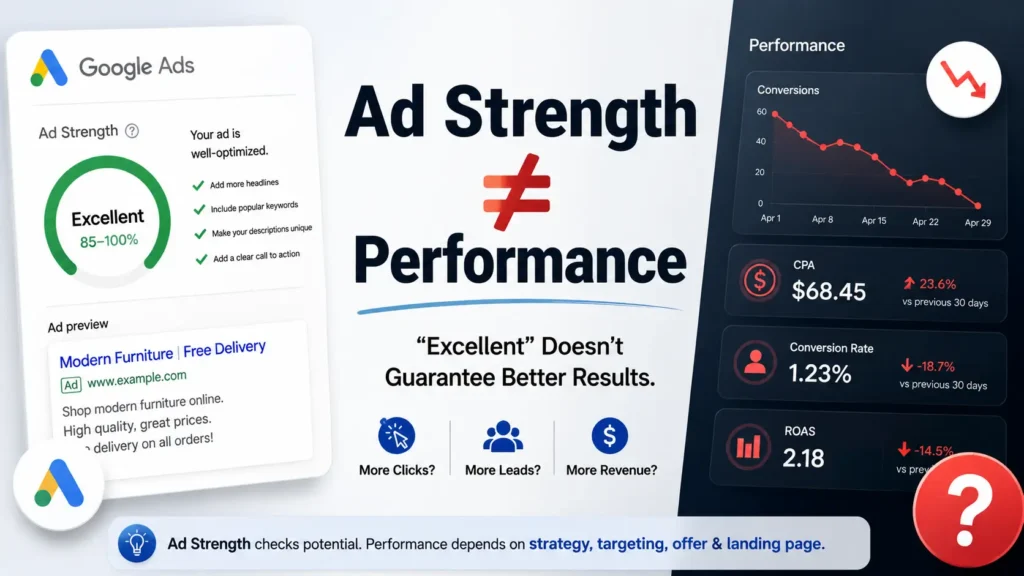
But conversions do not improve, lead quality remains unchanged, cost per acquisition continues to rise, sometimes performance even declines.
This often leaves advertisers wondering whether Ad Strength actually matters and, more importantly, whether an Excellent rating means what they think it means.
The reality is that Google Ads Ad Strength is a useful metric, but it is frequently misunderstood. It was designed to help advertisers create stronger Responsive Search Ads, not to predict business outcomes. Understanding that distinction can prevent countless hours of misplaced optimization and help advertisers focus on the factors that genuinely influence performance marketing outcomes, including conversion rates, customer acquisition costs, lead quality, and return on ad spend.
Understanding What Google Ads Ad Strength Actually Measures
One of the reasons Ad Strength is often misunderstood is because the name itself sounds like a performance metric.
When most people hear the phrase “ad strength,” they naturally assume it refers to how effective an advertisement is. They assume it reflects how likely an ad is to generate clicks, leads, sales, or revenue.
That is not what Google is measuring.
Ad Strength is primarily a creative evaluation tool. It assesses whether Google has enough assets available to create multiple ad combinations within a Responsive Search Ad. The system looks at factors such as headline variety, description diversity, keyword coverage, and the overall uniqueness of the messaging being provided.
In simple terms, Google wants advertisers to give its machine learning system more options.
If an advertiser supplies fifteen distinct headlines and four different descriptions, Google’s algorithm can test numerous combinations to determine which messages resonate best with different searchers. If the advertiser only provides a few repetitive assets, Google’s ability to experiment becomes limited.
From Google’s perspective, more variety generally creates more opportunities for optimization. That objective makes perfect sense.The problem occurs when advertisers assume that creative flexibility automatically translates into business success. Effective Google Ads management requires looking beyond platform recommendations and focusing on the metrics that directly influence business outcomes.
Any experienced Google Ads agency will evaluate factors such as search intent, conversion quality, cost per acquisition, landing page performance, and profitability rather than relying on Ad Strength as the primary measure of campaign success.
Why Many Advertisers Misinterpret Ad Strength
Part of the confusion comes from how Google Ads presents recommendations.
When advertisers open an account, they frequently see suggestions encouraging them to improve Ad Strength. The platform highlights missing headlines, insufficient descriptions, and opportunities to add more variation. Over time, many advertisers begin to associate a higher Ad Strength score with better campaign performance.
The relationship, however, is not nearly that straightforward.
An Excellent Ad Strength rating simply indicates that Google has sufficient creative assets to test. It does not indicate that the campaign is targeting the right audience. It does not evaluate whether the offer is compelling. It does not determine whether the landing page converts effectively. Most importantly, it does not measure whether the campaign is generating profitable business outcomes.
This distinction is critical because advertisers often spend significant amounts of time chasing a better Ad Strength score while overlooking far more influential performance factors.
In practice, campaigns rarely fail because they lack one additional headline variation. They fail because the wrong people are clicking, the landing page is weak, the offer lacks differentiation, or conversion tracking is inaccurate. An experienced PPC agency will typically focus on these fundamental performance factors rather than treating Ad Strength as the primary measure of campaign success.
The Difference Between Creative Optimization and Business Performance
A useful way to think about Ad Strength is to separate creative optimization from business performance.
Creative optimization focuses on giving Google enough material to test. Business performance focuses on generating profitable outcomes. These objectives overlap, but they are not identical.
Imagine two real estate advertisers promoting premium villas — a scenario our team experienced directly when managing the Western Park villa campaign in Hyderabad, where conversion quality consistently mattered more than Ad Strength ratings.
The first advertiser creates an ad with fifteen headlines, four descriptions, multiple calls to action, and extensive keyword coverage. Google rewards the effort with an Excellent Ad Strength rating.
The second advertiser creates a simpler ad that achieves only a Good rating.
If Ad Strength were the primary determinant of success, the first advertiser should consistently outperform the second.
In reality, that is not always what happens.
If the second advertiser has a stronger landing page, clearer pricing, a more compelling offer, and a better understanding of buyer intent, they may generate significantly more leads despite having a lower Ad Strength score.
This is why experienced advertisers rarely evaluate campaigns based on platform diagnostics alone. They focus on what happens after the click.
Search Intent Often Matters More Than Ad Strength
One of the most common reasons campaigns struggle despite Excellent Ad Strength is poor keyword intent. Google can display a beautifully optimized ad to the wrong audience. When that happens, performance suffers regardless of how many headlines have been added.
Consider a property developer targeting luxury villas. The Responsive Search Ad may include excellent messaging, strong value propositions, and extensive headline variation. Google may consider it an ideal example of a responsive ad.
However, if the campaign is attracting users searching for villa design ideas, architectural inspiration, or general property research, conversions may remain low. The issue is not the ad. The issue is that the traffic lacks commercial intent.
Experienced Google Ads managers spend far more time understanding search intent than they do obsessing over Ad Strength scores. They know that attracting the right visitor is often more important than perfecting the advertisement itself.
A highly motivated buyer can convert through a merely good ad. An unqualified visitor rarely converts through even the most sophisticated advertisement.
The Landing Page Is Frequently the Real Problem
Another reason advertisers overestimate the importance of Ad Strength is that they evaluate campaigns too narrowly. They focus on what happens before the click while ignoring what happens afterward. In many accounts, the advertisement performs adequately. The landing page is where conversions are lost.
A user clicks an ad expecting to learn about a specific service, product, or property. Instead, they arrive on a page that loads slowly, provides limited information, buries important details, or fails to establish trust. Within seconds, the visitor leaves.
The advertiser sees poor conversion rates and assumes the ad requires improvement.In reality, the problem may have nothing to do with the advertisement. Landing pages influence user confidence, information accessibility, and conversion behavior — which is why conversion rate optimisation is as important as the ad itself in any high-performing Google Ads campaign. Even relatively small improvements in page experience can produce greater gains than extensive adjustments to Ad Strength.
This is one reason experienced advertisers evaluate the entire conversion journey rather than isolated metrics.
Why Offers Still Win
Advertising history repeatedly demonstrates one important principle: strong offers outperform weak offers. No amount of headline variation can fully compensate for a lack of compelling value.
Suppose two businesses offer similar services. One company advertises generic solutions with no clear incentive. The other provides a free consultation, transparent pricing, faster turnaround times, or a meaningful guarantee. Even if both advertisers achieve similar Ad Strength scores, the stronger offer frequently wins. Customers make decisions based on perceived value.
Ad Strength influences how Google assembles ad combinations. It does not determine whether the underlying proposition is attractive to buyers. Businesses that focus exclusively on platform recommendations often forget that consumers do not purchase because an ad achieved an Excellent rating. They purchase because the offer solves a problem or fulfills a need.
What Experienced Advertisers Measure Instead
One of the clearest differences between beginner and experienced Google Ads managers is the metrics they prioritize. New advertisers often focus on diagnostic scores. Experienced advertisers focus on business outcomes.
When evaluating campaign performance, metrics such as conversion rate, cost per lead, cost per acquisition, lead quality, and return on ad spend typically provide far more insight than Ad Strength.
A campaign generating high-quality leads at an acceptable acquisition cost is successful regardless of whether the Ad Strength rating is Good or Excellent. Likewise, a campaign generating expensive, low-quality leads remains problematic even if Google provides perfect optimization scores.
The purpose of advertising is not to satisfy platform recommendations. The purpose is to generate profitable business growth. Every optimization decision should ultimately support that objective.
Is Ad Strength Still Important?
Despite its limitations, dismissing Ad Strength entirely would be a mistake. The metric exists for a reason.
Many advertisers historically created ads with minimal variation. They reused similar headlines, duplicated descriptions, and provided Google’s system with very little flexibility. Responsive Search Ads were introduced to solve that problem.
Ad Strength encourages advertisers to think more broadly about messaging. It pushes them to test different value propositions, explore alternative calls to action, and create more diverse creative assets. In many cases, this process improves ad quality and contributes positively to campaign performance.
The key is understanding where Ad Strength fits within the optimization hierarchy. It should be viewed as a helpful diagnostic tool rather than a measure of success. If your campaign has Poor Ad Strength, addressing the issue is worthwhile.
If your campaign has Good Ad Strength and strong business results, spending hours chasing an Excellent rating may provide little incremental value.
Should You Aim for Excellent Ad Strength?
The practical answer is yes—but with context. Advertisers working with a professional Google Ads management team should absolutely follow sensible best practices. They should create multiple headlines, write unique descriptions, incorporate relevant keywords naturally, and give Google’s machine learning system sufficient material to test.
If those efforts result in an Excellent rating, that is a positive outcome. What advertisers should avoid is treating the rating itself as the goal. The objective is not to achieve Excellent Ad Strength.
The objective is to generate more qualified leads, sales, revenue, and profit. Sometimes those goals align perfectly; sometimes they do not. When conflicts arise, bottom-line profitability should always take priority.
The Metric Matters Less Than the Outcome
Google Ads Ad Strength has become one of the most discussed metrics inside modern advertising accounts, yet it remains one of the most misunderstood.
An Excellent rating indicates that Google has enough creative assets to test multiple combinations and optimize messaging. It does not indicate that the campaign will produce more conversions. It does not guarantee lower acquisition costs. It does not ensure profitability.
Campaign success depends on a much broader combination of factors, including search intent, audience quality, offer strength, landing page experience, bidding strategy, conversion tracking, and overall business relevance.
The most successful advertisers understand this distinction. They use Ad Strength as a guide rather than a destination. They appreciate its value without allowing it to distract from the metrics that truly matter.
At the end of the day, customers do not see your Ad Strength rating:
They see your message.
They evaluate your offer.
They interact with your landing page.
And they decide whether your business deserves their trust.
Those decisions—not the color of a badge inside Google Ads—are what ultimately determine campaign success.
Frequently Asked Questions
What is Google Ads Ad Strength?
Google Ads Ad Strength is a diagnostic metric that evaluates the quality and diversity of assets within a Responsive Search Ad. It helps advertisers create more varied ad combinations but does not directly measure campaign performance.
Does Excellent Ad Strength improve conversions?
Not necessarily. While stronger ad assets may improve testing opportunities, conversions depend on factors such as keyword intent, landing page experience, audience quality, and offer relevance.
Is Ad Strength more important than Quality Score?
No. Both metrics serve different purposes. Ad Strength evaluates creative diversity, while Quality Score focuses on expected click-through rate, ad relevance, and landing page experience.
Why is my Ad Strength Excellent but leads are low?
This often occurs when campaigns attract low-intent traffic, have weak landing pages, poor offers, inaccurate conversion tracking, or audience targeting issues.
Should I prioritize Ad Strength or conversion rate?
Conversion rate should always take priority because it directly reflects business outcomes. Ad Strength is a useful optimization tool but not a primary performance metric.
Can campaigns with Good Ad Strength outperform campaigns with Excellent Ad Strength?
Yes. Better keyword targeting, stronger offers, and higher-converting landing pages can easily outperform campaigns that simply have higher Ad Strength scores.
What metrics matter more than Ad Strength?
Most experienced advertisers focus on conversion rate, cost per lead, cost per acquisition, lead quality, return on ad spend, revenue, and profitability.
Is it worth improving Ad Strength from Good to Excellent?
It can be worthwhile if improvements are meaningful. However, advertisers should avoid spending excessive time chasing small rating increases when larger opportunities exist elsewhere in the account.