There is a version of this audit that gets run all the time. Open Search Console, check impressions and average position, pull the domain authority from Ahrefs, scan the coverage report for index errors. That is the standard way to check website search engine visibility, and it is genuinely useful.
It also misses an entire category of search engine.
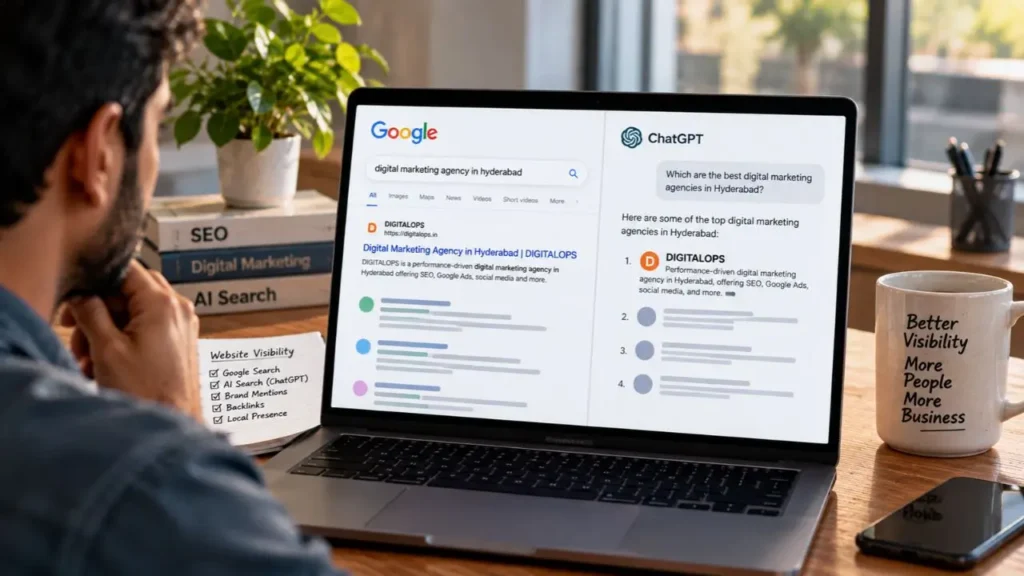
ChatGPT, Gemini, Perplexity, and Google’s own AI Overviews are making recommendations to buyers right now. Ask any of them who the best SEO agency in Hyderabad is, or which construction company to hire in San Jose, or which accounting software works for a small business, and they return a short list of names. Those names are not chosen by ranking position. They come from entity recognition, content quality, and how well a business is represented across the web.
Your Search Console data does not show whether you are on that list. Your domain authority score does not either. The businesses that are not checking this are losing leads they do not know they are losing.
The Two-Engine Problem
For most of the internet’s history, checking search visibility meant checking Google. Bing existed, but the traffic difference was significant enough that most businesses treated Google as the only engine worth optimising for.
That has changed, and it has changed faster than most audits have caught up with.
AI assistants are now search engines by function. A user asking Perplexity which digital marketing agency to hire, or asking ChatGPT to compare two SaaS products, is doing exactly what a Google user does — except the result is a curated answer that names specific businesses, not a list of links. There is no position three on this result. There is a short list, and either your business is on it or it is not.
The signals that put you on that list are not the same signals that put you on page one of Google. That is the core problem. Businesses with strong Google rankings assume they have strong search visibility overall. Many of them do not.
How to Check Traditional Search Engine Visibility
Start with Google Search Console. It is the most direct source of data you have – Google itself telling you how your pages are performing in its results.
The most important reports to look at are the Search Results performance report and the Coverage report. In the performance report, look at the keywords where you have impressions but a low click-through rate. These pages are ranking but not compelling enough to click. The fix is usually the title or meta description. Then look for keywords where your average position sits between 5 and 15 – these are pages close enough to page one that targeted work will move them.
The Coverage report shows which pages are indexed and which are not. Unindexed pages are invisible. Common causes are accidental noindex tags, canonicalization errors, or pages blocked in the robots.txt file. It takes ten minutes to check and businesses routinely find important pages sitting there excluded.
After Search Console, a domain authority check in Ahrefs or Semrush gives you a sense of how much ranking power your site has relative to competitors. If your competitors have a domain rating of 50 and yours is 25, authority is the gap. If you are at 45 and they are at 40 but they still outrank you, authority is not the issue and you need to look elsewhere.
Core Web Vitals is worth checking too. Google uses page experience as a ranking signal, and a page that fails speed and usability thresholds will rank below a comparable page that passes them. Search Console flags the specific pages that need attention.
That covers traditional visibility. Most SEO audits stop here.
The Check Most Businesses Have Not Done
Ask ChatGPT what it knows about your business. Right now, before you read the rest of this.
Ask it: “what is [your business name]” and “what does [your business] do.” Then ask a buyer question your customers actually use: “best [your service] in [your city]” or “who are the top [your industry] companies in [your region].”
The results will be one of three things. Your business appears accurately and in the right context. Your business appears but the description is wrong or outdated. Your business does not appear at all.
A significant number of businesses that run this check for the first time find themselves in the third category. They have reasonable Google rankings, a functioning website, even some backlinks. But to AI, they do not exist as a named entity worth recommending.
This is what AI search visibility means, and it is the part of the visibility picture that a traditional audit does not touch.
Why the Signals Are Different
Traditional Google rankings are driven primarily by backlinks, technical SEO, and on-page keyword optimisation. More authority from credible links, technically sound pages, content that matches what people search. That formula has held for two decades.
AI answer engines work differently.
They are looking for entity signals – whether your business exists as a recognised, consistent entity across the web. A company with a clear name, consistent contact details, mentions in credible publications, and a presence in relevant directories is a known entity. AI systems are more likely to name a known entity than an anonymous one, regardless of how many backlinks it has.
They are also looking for content specificity. A service page that describes what you do in general terms is nearly impossible for an AI to cite helpfully. A page that includes real results, case study details, and direct answers to the questions buyers ask is exactly what AI systems pull from. The difference between “we offer SEO services to help your business grow” and a page with specific rankings data, client names, and defined outcomes is enormous in terms of AI citation likelihood.
Structured FAQ content matters too. Questions followed by direct, specific answers are among the formats AI systems are most likely to reference. If your site has no FAQ sections, or the ones it has are vague, this is a gap worth addressing.
What We See When We Run Both Audits
Across the clients DIGITALOPS works with in India and internationally, the pattern is consistent. Almost every business that comes in for an SEO audit has reasonable traditional visibility – they are indexed, their domain authority is in a workable range, they have some page-one rankings. Very few of them have done the AI side of the check.
When we run the AI queries, the gaps are obvious. Competitors are being named in AI answers. Our client is not. The competitor does not always have better Google rankings – sometimes they have lower domain authority. What they have is more specific content, more structured FAQ coverage, more brand mentions in relevant contexts.
The fix is not a different backlink strategy. It is a content and entity strategy, and it runs alongside the traditional SEO work rather than replacing it.
For Hyders Construction in California, a client we started working with in September 2025, the entire campaign was built on local SEO and content fundamentals with no link-building component. Eight keywords reached page one within a year, including the top position for ‘construction companies in San Jose California’, sustained for four months. The visibility came from content that specifically answered local buyer intent, not from domain authority.
That kind of result does not show up in a traditional backlink audit. It comes from understanding what the search engines, including AI, are actually looking for.
Checking Both: A Practical Workflow
Here is a straightforward way to run both checks without making it a week-long project.
For traditional visibility: Google Search Console for impressions, click-through rates, average position, and index coverage. Ahrefs or Semrush for domain authority relative to competitors. Core Web Vitals in Search Console for page experience. Budget two hours for a proper review.
For AI visibility: The free AI Search Audit tool runs the AI queries for you. Enter your website URL and it checks how ChatGPT and other AI assistants currently describe your business, asks a live buyer question in real time, and returns a structured read on what is stopping AI from recommending you. It takes a few minutes and gives you a clear picture of the AI gap.
Run both. Look at the two pictures together. The gap between your Google visibility and your AI visibility tells you more about where your search presence actually stands than either audit does alone.
If traditional SEO fundamentals need attention alongside the AI work, the SEO services side of what we do covers the technical and content side – building the organic base that supports visibility in both systems.
Frequently Asked Questions
How do I check my website’s search engine visibility for free?
Google Search Console is the primary free tool for traditional visibility - it shows your organic impressions, click-through rates, average ranking positions, and index coverage directly from Google. For AI search visibility, the free AI Search Audit at DIGITALOPS runs live queries against ChatGPT and other AI assistants and shows how your business currently appears in AI-generated answers.
What is the difference between traditional search engine visibility and AI search visibility?
Traditional visibility is about how your pages rank and perform in Google results. AI visibility is about whether ChatGPT, Gemini, and Perplexity include your business when buyers ask relevant questions. The signals that drive each are different - Google rewards backlinks, technical SEO, and keyword relevance, while AI systems reward entity recognition, content specificity, and structured information. You can have strong rankings in one and be invisible in the other.
Why is my website not showing up in search results?
The most common causes are pages not being indexed by Google (check the Coverage report in Search Console), insufficient domain authority to compete in your niche, content that does not match what users are actually searching for, or a technical issue like an accidental noindex tag. For AI results, the most common cause is thin or generic content that AI systems cannot cite helpfully, combined with low entity recognition.
How do I improve AI search visibility?
Build entity authority through consistent business information across directories and the web, write content that gives specific answers rather than general descriptions, add structured FAQ sections to key pages, and generate brand mentions in credible publications and industry sources. An AI search audit shows you exactly which of these gaps to address first.
How often should I check both types of visibility?
Traditional Search Console data is worth reviewing monthly, or weekly during active campaigns. AI visibility shifts as AI systems update, so a quarterly check is a reasonable minimum - and running the audit after any significant website update makes sense too.
Do strong Google rankings guarantee AI visibility?
No. A site can hold strong Google rankings while being entirely absent from AI answers. The two systems use different signals. We see this regularly with clients who come in with healthy domain authority but no AI presence. The fix is content and entity work, not more links.
The Full Picture
A rankings report tells you where you stand on Google. It does not tell you whether a buyer who asked ChatGPT for a recommendation ever heard your name.
Both checks are worth running. The businesses that will have the strongest search presence going forward are the ones treating AI visibility as a standard part of the audit, not an afterthought.