Why Local SEO Is More Than Google Business Profile
Most businesses believe local SEO starts and ends with Google Business Profile. They optimise the listing, upload photos, collect a handful of reviews, and wait. When a competitor with a less polished profile still outranks them, the confusion is genuine.
Here is the reality: Google Business Profile is the front door of local SEO — the most visible piece. But the building behind that door is far larger than most businesses ever explore. Local SEO beyond Google Business Profile is what separates businesses that occasionally appear in the local pack from those that own it, consistently, across multiple queries, and increasingly across AI-generated local answers in Google AI Overviews, ChatGPT, and Perplexity.
This guide covers every local ranking signal that lives outside your GBP: the ones Google has weighted for years, the ones AI answer engines now use to decide which local businesses they cite, and the specific actions that actually move rankings.
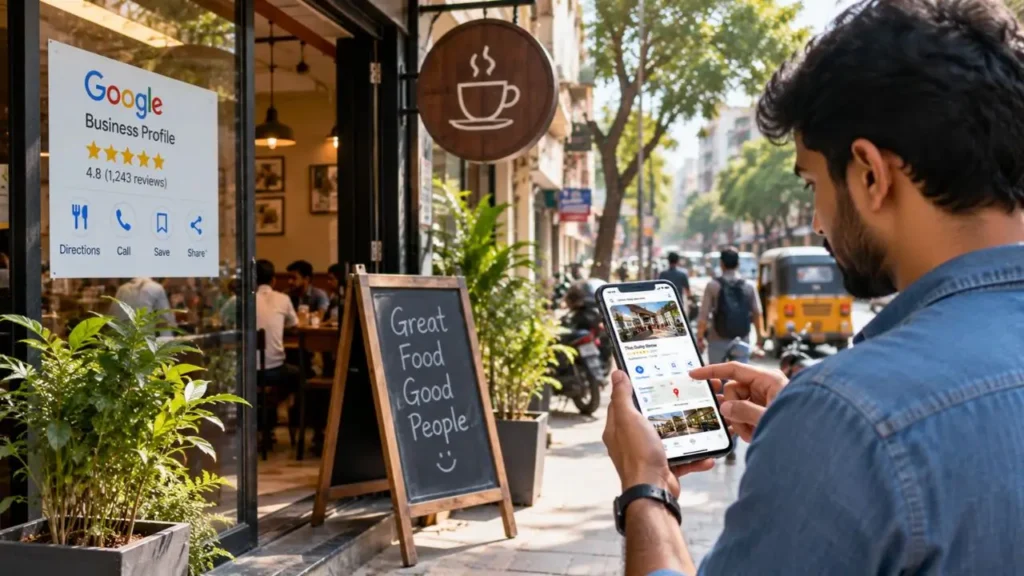
How Google Defines Local Ranking – And Why GBP Is Only One Third of It
Google’s documentation on local search is unusually transparent. Three factors determine local rankings: relevance, distance, and prominence.
Google Business Profile directly influences relevance and provides location data for distance calculations. It has almost no bearing on prominence — which Google defines as how well known a business is. Prominence comes from the web at large: links pointing to your website, mentions of your business across the internet, the depth of content on your pages, and your presence across review platforms and directories.
When one of the three core local ranking factors is built almost entirely outside your GBP, profile optimisation alone can only take you so far. The businesses competing seriously for local rankings are building authority signals that no amount of GBP optimisation can replicate.
NAP Consistency – The Foundation Most Businesses Skip
NAP stands for Name, Address, Phone Number. Your business information exists across hundreds of places online — your website, Google Business Profile, Justdial, Sulekha, IndiaMART, Facebook, TradeIndia, and dozens of data aggregators that feed local directories globally.
When this information is inconsistent — different phone numbers on different platforms, abbreviated address formats, old locations never corrected — Google can’t fully trust any of it. Inconsistent NAP creates what SEOs call citation noise, and it actively suppresses local rankings by lowering Google’s confidence in your business data.
NAP consistency means the exact same business name (not “Digital Ops” in some places and “DIGITALOPS” in others), the exact same address format down to whether you write “Road” or “Rd”, and the same primary phone number across every platform. Getting this right is tedious. But it is also permanent — once your NAP is clean across 50-plus directories, it stays clean unless something changes. Most competitors have never done this work. It is a genuine, sustainable edge.
For businesses in Hyderabad: Indian platforms — Justdial, IndiaMART, Sulekha, TradeIndia — carry real weight in Google’s local data ecosystem. These are not optional citations. If your NAP on Justdial does not match your GBP exactly, you are leaving local ranking signals on the table every single day.
Local Landing Pages – The Most Underbuilt Asset in Local SEO
If your business serves multiple areas or wants to rank for area-specific queries, you need dedicated local landing pages on your website. Not city names dropped in your footer. Not a service areas page listing eight cities in a paragraph. Actual pages built for each location.
A well-built local landing page includes a unique H1 combining your service and location (“Digital Marketing Agency in Madhapur, Hyderabad”), original body content that is not copied from other location pages, location-specific details such as nearby landmarks or local industries you serve, an embedded Google Map, LocalBusiness schema markup, local testimonials, and internal links to your core service pages.
GBP tells Google where you are. Local landing pages tell Google what you do there, for whom, and with what depth of expertise. They are the content signal that your GBP fundamentally cannot provide.
The minimum effective length for a local landing page is 600 to 800 words. Thinner than that and Google categorises it as a doorway page rather than a genuine local resource — and doorway pages are filtered out of rankings.
On-Page Local SEO Signals Your Website Must Have
Your website is the most powerful local SEO asset you control. Unlike GBP, where you are partially dependent on how Google chooses to display information, your website is entirely yours. These are the on-page signals that feed directly into local rankings:
Location in the title tag. Every local service page needs the location in the title. “SEO Services in Hyderabad” outperforms “SEO Services” for Hyderabad-based queries consistently, because the title tag remains one of Google’s strongest relevance signals.
Location in the meta description. Location keywords in your meta description improve click-through rates on local search results pages. Higher CTR is itself a ranking signal.
Location in H1 and early body copy. Google parses your heading structure to understand what a page is about. If your H1 says “Digital Marketing Services” and you want to rank in Hyderabad, you are missing the most important on-page local signal available to you.
Footer NAP. Your full business name, address, and phone number in your website footer — formatted identically to your GBP listing — reinforces NAP consistency across your own domain.
A contact page with full address. Google cross-references the address on your Contact page against your GBP. Discrepancies, however minor, introduce doubt. Alignment reinforces trust.
Local Schema Markup – What AI Search Engines Actually Read
Schema markup is structured data added to your website’s HTML that tells search engines — and AI systems — exactly what your business is, where it operates, what it offers, and who it serves. For local SEO, three schema types matter most.
LocalBusiness schema (or a specific subtype like MedicalClinic, LegalService, or RealEstateAgent) is the foundation. It communicates your business name, address, phone number, opening hours, URL, and geographic area served in a format Google and AI engines can read directly without having to parse your page copy.
Service schema allows businesses with multiple services to define each offering with its own name, description, and service area. This is the signal AI answer engines use when someone asks a question like “which digital marketing agencies in Hyderabad offer local SEO” – they pull structured service data to construct the answer.
FAQPage schema makes your question-and-answer content machine-readable. When you add FAQ schema to a local page, the answers become eligible for expanded search features and, critically, become easily parseable by AI systems assembling local answers.
Google AI Overviews, ChatGPT’s browsing capability, and Perplexity all use schema data to understand and cite local businesses. A business with clean LocalBusiness, Service, and FAQ schema is significantly more likely to appear in an AI-generated local answer than one relying solely on GBP — even when the two businesses have comparable profiles.
Review Signals Beyond Google
Prominence in Google’s local algorithm is shaped by reviews across the entire web, not just Google. Facebook reviews, Yelp ratings, industry-specific platforms like Practo for healthcare or Housing.com for real estate, and written mentions of your business on third-party websites all contribute to how prominently Google features a local business.
The review signals that carry weight include total review count across platforms, recency of reviews (the past three months matter more than older reviews), your response rate (businesses that respond consistently to reviews – including negative ones — outrank those that do not), review sentiment (Google’s NLP reads review text for service keywords, not only star ratings), and third-party written mentions that function simultaneously as citations and review signals.
The most practical step for most businesses: build a review request process that extends beyond Google. For healthcare businesses, prioritise Practo. For real estate, Housing.com. For B2B, LinkedIn recommendations alongside Google reviews. A diversified review presence signals prominence in a way that Google-only review campaigns cannot match.
Local Link Building – The Signal That Creates Real Separation
Backlinks from local websites are the most powerful prominence signal in local SEO. A link from the Hyderabad Chamber of Commerce, a local business publication, a neighbourhood resource website, or a Hyderabad-specific directory carries geographic authority that a national or generic link cannot replicate.
High-value local link sources include local news websites and online publications, Hyderabad-specific business directories and trade associations, local event sponsorships where your business name appears on the event website, university and college websites in the city if you offer internships or workshops, co-citations with other local businesses on community resource pages, and local industry awards or recognition lists.
The goal is relevance, not volume. Five genuine links from Hyderabad-based websites outperform fifty generic directory links from national sites. Google’s local algorithm specifically weights the geographic proximity and authority of the linking domain – which is why local link building produces ranking results that no amount of national link acquisition can replicate for local queries.
Local Content Strategy – Writing for Your City, Not Just About It
There is a difference between content that mentions a location and content that is about a local market.
“We provide digital marketing services in Hyderabad” is keyword placement. “Why Hyderabad’s real estate developers are investing in digital marketing ahead of RERA compliance cycles” is local context. The second signals genuine local relevance, uses city-specific market knowledge, and naturally attracts links and citations from local audiences.
Local content formats that consistently perform well include industry-specific local guides such as “SEO for Healthcare Clinics in Hyderabad”, local case studies with real outcomes, local event or industry commentary, comparison content that serves a genuine research intent, and FAQ content targeting hyper-specific local queries like “Does Google Ads work for small businesses in Hyderabad.”
This kind of content builds topical authority in your city — Google’s understanding that your website is the most thorough, credible local resource on a given topic. Topical authority, once established, produces rankings that are far more stable and defensible than listings built on GBP optimisation alone.
How AI Answer Engines Handle Local Queries
As search continues shifting toward AI-generated answers, the mechanics of local discovery are evolving. Google AI Overviews, Perplexity, and ChatGPT increasingly answer queries like “best digital marketing agency in Hyderabad” with synthesised responses — selecting which businesses to cite based on structured data, review signals, content depth, and citation consistency across the web.
The local businesses most likely to appear in AI-generated local answers have clean structured data including LocalBusiness and Service schema, consistent NAP across all platforms so AI systems can confidently attribute information to them, review presence across multiple platforms providing third-party validation, content that directly answers related questions through FAQ sections and local guides, and citations from authoritative local sources like city directories, news sites, and business associations.
This is why local SEO beyond Google Business Profile is no longer just a search engine conversation — it is an AI visibility conversation. Every NAP citation you clean up, every local page you build, every schema block you add is contributing to a local authority footprint that AI systems use to decide which businesses get named in their answers. The businesses building these signals now are creating a structural advantage that will compound over the next several years of AI-driven search.
What This Means for Your Local Rankings
Google Business Profile is necessary. It is not sufficient. The businesses that dominate local search in competitive markets have built something that cannot be replicated quickly: a consistent NAP footprint across the web, a network of local links, a content library demonstrating genuine local expertise, and schema markup that makes them readable to both search engines and AI systems. None of this is complicated.
All of it requires consistent, systematic work that most competitors skip because their profile looks reasonable and they do not understand why it is not ranking. That gap between businesses investing in the full local SEO picture and those still treating it as profile management is where real ranking separation happens — and where it will keep happening as AI-generated local answers become the primary way people discover local businesses.
DIGITALOPS helps businesses in Hyderabad and across India build the kind of local SEO foundation that produces rankings search engines and AI systems both recognise. If you want to understand exactly where your local authority is falling short, start with a free local SEO audit.
Frequently Asked Questions
What does local SEO beyond Google Business Profile include?
Local SEO beyond Google Business Profile includes every ranking signal that exists outside of your GBP listing: NAP consistency across directories and citation sources, dedicated local landing pages on your website, on-page optimisation with location signals in title tags and headings, LocalBusiness and Service schema markup, reviews and mentions across non-Google platforms, backlinks from geographically relevant local websites, and content specifically written about your local market and industry context.
Why doesn't optimising my Google Business Profile alone produce strong local rankings?
Google Business Profile alone does not produce strong local rankings because it influences only two of Google's three ranking factors — relevance and distance — and has almost no bearing on prominence, which is built entirely outside your GBP listing.
What is NAP consistency and why does it affect local rankings?
NAP stands for Name, Address, Phone Number. Google cross-references your business information across hundreds of web sources to verify legitimacy and assess prominence. When your NAP is inconsistent across platforms — different formats, outdated phone numbers, or old addresses — it creates citation noise that reduces Google's confidence in your business data and suppresses local search visibility.
How does schema markup help with local SEO and AI search?
Schema markup adds machine-readable structured data to your website, allowing search engines and AI systems to directly understand what your business is, where it operates, and what services it provides. For local SEO, LocalBusiness schema establishes your geographic context, Service schema defines your offerings for AI query matching, and FAQPage schema makes your answers citable in AI-generated responses. Businesses with clean schema are significantly more likely to be cited in Google AI Overviews and other AI answer engines.
What types of links improve local SEO?
Local link building focuses on backlinks from geographically relevant sources: local news websites, city-specific business directories, regional trade associations, local event websites, and community resource pages. These links carry geographic authority that directly influences Google's prominence calculation for local queries. Five links from genuine Hyderabad-based websites typically deliver more local ranking impact than fifty links from generic national directories.
How is local content strategy different from general content marketing?
Local content strategy produces content that is about your specific market — its industries, regulations, competitive dynamics, and business environment — rather than content that simply mentions your city as a location tag. This type of content demonstrates genuine local expertise, attracts links from local audiences, and builds the topical authority that makes your website Google's most credible local resource on a given topic. Topical local authority produces more stable rankings than keyword placement alone.
How long does local SEO beyond Google Business Profile take to show results?
NAP consistency and on-page fixes typically show ranking movement within 4 to 8 weeks. Local landing pages and schema changes can impact visibility in 2 to 6 weeks once Google re-crawls the page. Local link building and review diversification are slower — expect 3 to 6 months for those signals to compound into measurable ranking improvement.