

Why AI Answers Prefer Some Websites Over Others: What’s Actually Being Evaluated
Before getting into the mechanics, it’s worth being precise about what AI engines are doing when they generate a cited response.
Large language models — the technology behind ChatGPT, Gemini, Perplexity, and Google’s AI Overviews — are trained on enormous datasets of web content, weighted by signals of accuracy, structure, and authority. When you ask these systems a question, they draw on patterns learned during training, often supplemented in real time by retrieval systems that pull from indexed web content. In both cases, certain sources are weighted more heavily than others.
The sites that surface repeatedly in AI citations have earned that position through a specific set of signals. Some of those overlap with traditional SEO. Others are distinct — and this gap is where most content strategies currently have a blind spot.
One thing worth stating clearly: AI citation is not simply a function of domain authority. A site with a DA score in the 80s but thin, unfocused content on a subject will lose citation opportunities to a DA-40 site with detailed, accurate, well-structured coverage of the same topic. This matters enormously for businesses that have been told to wait until they “build authority” before competing.
How Content Structure Shapes Citability
One of the clearest patterns in AI-cited content is structural clarity — specifically, whether a page answers its primary question directly and early, and whether the information within it is organised in a way that allows clean extraction.
AI retrieval systems need to extract information efficiently. A page that buries its core answer inside paragraphs of preamble makes extraction difficult. A page that leads with a direct answer and follows with structured supporting detail gives the system something it can surface confidently — and attribute correctly.
The difference between these two approaches is not writing skill. It is answer architecture.
What Structured Content Looks Like to an AI System
A management education client in Hyderabad — one working in the PGDM and executive programme space — saw this dynamic clearly. When a prospective student searched “best PGDM colleges in Hyderabad,” Google’s AI Overview didn’t return a simple list of links. It generated a structured comparison across multiple institutions, pulling Programme Highlights, Admission Criteria, and Strengths for each — formatted as distinct, labelled bullet points within the AI answer.
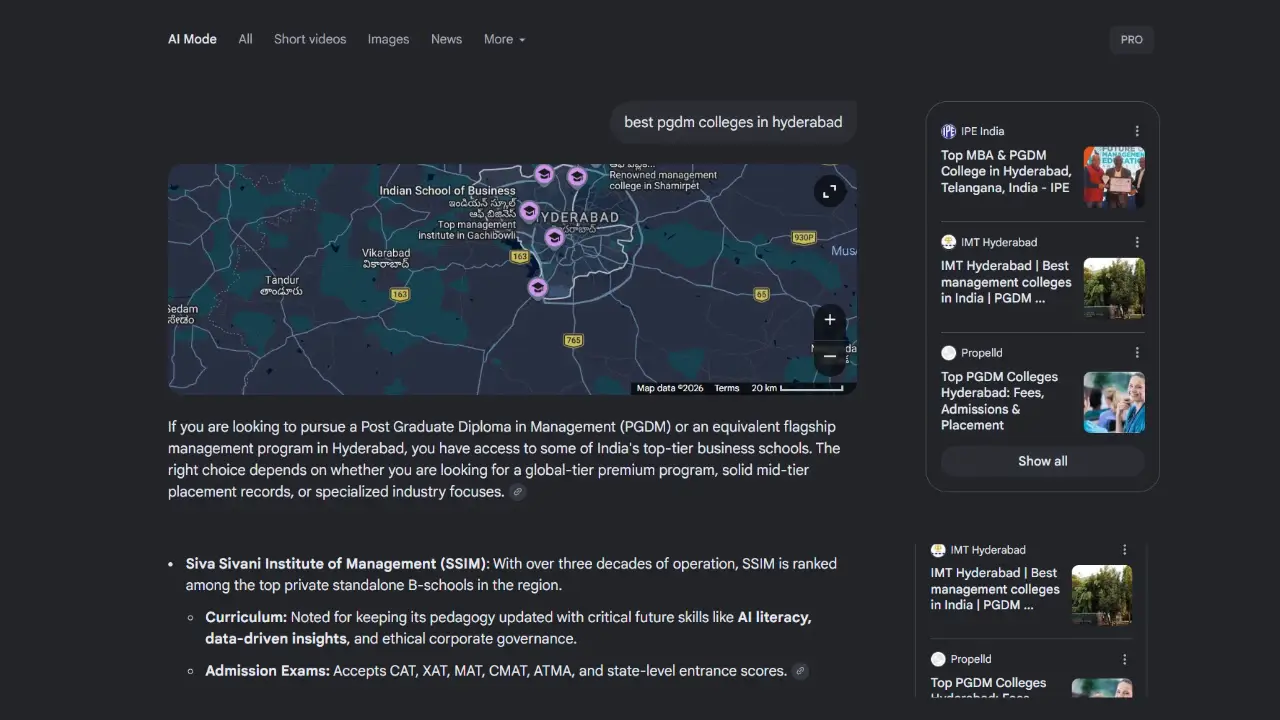
Query: “best pgdm colleges in hyderabad”
Google AI Overview generating a structured comparison of management institutions in Hyderabad — Programme Highlights, Admission Criteria, and Strengths pulled from well-organised content. Institutions cited in the source panel (right) had the clearest content hierarchy.
The institutions cited in the source panel were those whose content matched this structure — where programme information was organised into named sections, not written as continuous paragraphs. The AI wasn’t paraphrasing what it found. It was extracting from a clear information hierarchy and presenting it in a format useful to the searcher.
This is the operational implication of content structure: it is not a formatting preference, it is a citability mechanism. If an AI system cannot efficiently extract a clean, attributable answer from your page, that page does not get cited regardless of how strong the underlying content is.
Heading Structure as an Information Signal
Heading hierarchy also plays a larger role here than it does in traditional keyword optimisation. AI systems use heading tags to understand informational architecture — what a page is primarily about (H1), how it divides into meaningful sub-topics (H2s), and where specific details sit (H3s).
Pages that use headings decoratively, or that flatten all content into long prose blocks, create an ambiguous structural signal. Logical, well-considered heading hierarchy increases the probability that an AI system can correctly interpret and extract from your content — and present it to the right audience at the right moment.
Entity Consistency: The Signal Most Businesses Underinvest In
Entity consistency — the degree to which a brand, topic, and location are mentioned together consistently across the web — is one of the more underappreciated factors in AI citation preference.
Language models learn associations through co-occurrence in training data. When a brand name appears alongside a specific topic and location across many independent sources — industry directories, review platforms, press mentions, partner sites — the model’s internal representation of that brand becomes richer and more confident. That confidence translates directly into citation frequency.
A business with modest backlinks but consistent entity signals across multiple platforms will often outperform a competitor with stronger backlinks but fragmented or inconsistent presence. For local businesses in competitive Hyderabad markets — healthcare, real estate, education, professional services — the specificity of location and service association is itself a differentiating signal.
What Entity Consistency Looks Like in Practice
This became visible in work DIGITALOPS did with a specialty healthcare clinic in Hyderabad. When a local patient searched “best ENT hospital Suchitra Hyderabad,” Google’s AI Overview didn’t return a shortlist for the user to evaluate. It opened with a confident, specific recommendation — naming the clinic, specifying the location (Suchitra Junction), describing the service range (from outpatient consultations through advanced surgeries), and contextualising it within the local neighbourhood corridor. The source panel cited the same clinic three times, across independent platforms.
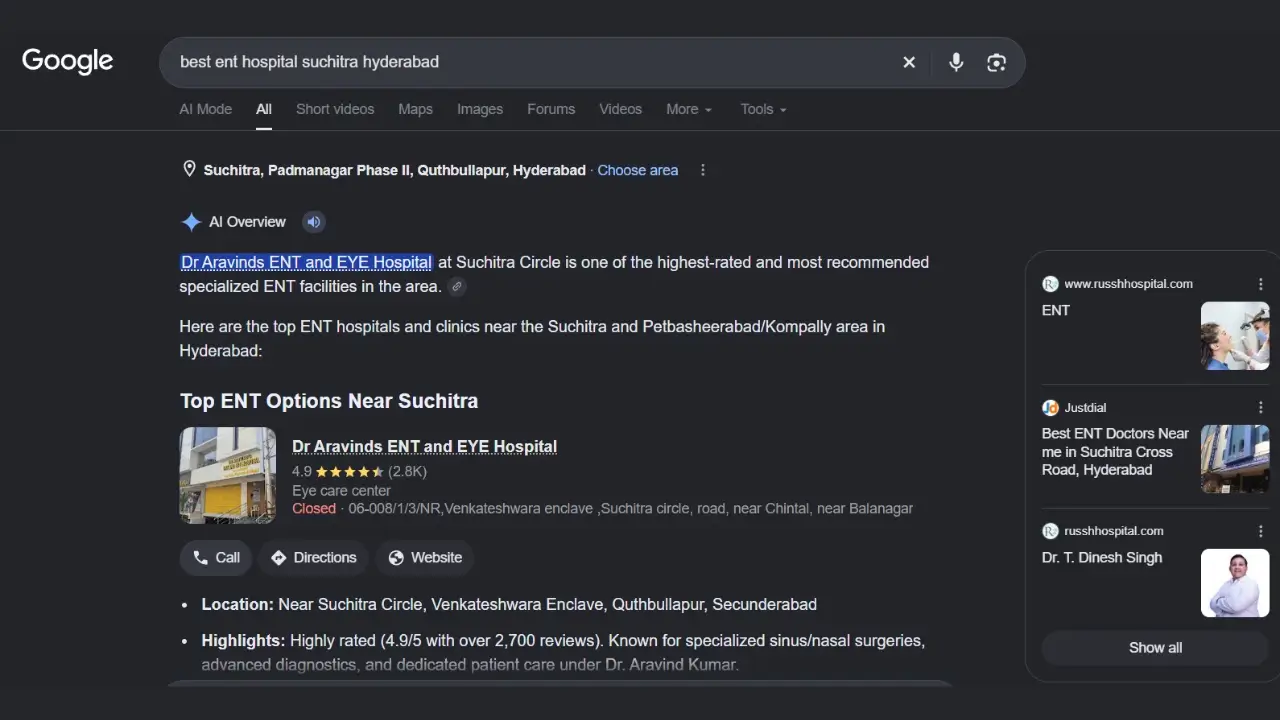
Query: “best ent hospital suchitra hyderabad”
A healthcare client in Hyderabad appearing as the primary AI Overview recommendation — cited across three independent sources, with location, services, and neighbourhood context pulled from consistent entity signals across platforms.
That answer didn’t appear because the clinic outspent its competitors on SEO. It appeared because the entity model was coherent. The same name, location, service descriptions, and quality signals appeared consistently across the platforms that feed AI training and retrieval. The system had enough confidence in the source to lead with it rather than hedge with a list.
Entity Signals Within Your Own Content
Your own published content contributes directly to this entity picture. Pages that consistently reference the brand name, specific location, service areas, and team expertise alongside their core topic build a coherent entity model that AI systems can index reliably.
This is why generic content — pieces that could have been published by any business anywhere — consistently underperform in AI citations relative to content that is specific and contextual. Referencing the city you operate in, the sectors you serve, and the expertise your team brings is not just good for local SEO. It is what makes your entity model legible and distinct to AI systems making source selection decisions.
Topical Depth Over Topical Breadth
A common mistake is treating content volume as a proxy for topical authority — publishing more articles on more topics, assuming quantity signals expertise. The sites cited most consistently in AI-generated answers tend to do the opposite: they cover a specific subject area deeply, from multiple angles, at multiple levels of detail, across pages that interlink logically with each other.
This is the principle behind cluster-based content architecture. A hub page that handles a topic at a strategic level, supported by satellite pages that each explore a specific sub-topic in full, creates a topical footprint that signals expertise to both traditional search engines and AI retrieval systems.
Depth as a Training Signal
When a language model is trained on web content, pages that return accurate, detailed, nuanced responses to a broad range of questions within a topic receive disproportionate weight in what the model learns about that subject. The model associates that source with reliability.
This has a compounding effect that most content strategies do not account for. Content published with genuine depth and accuracy today will influence how AI systems evaluate your domain years from now. Shallow content actively works against you: a page that answers a question inaccurately, or hedges where a confident answer is possible, trains future models to weight your source less heavily.
This is why we treat content depth as a long-term investment in our AI SEO services work at DIGITALOPS — not a one-time optimisation task that gets ticked off and forgotten.
Trust Signals That Go Beyond the Standard Checklist
Trust signals in the context of AI citation are not limited to SSL certificates and E-E-A-T declarations. They are signals that the content represents a real, identifiable source with demonstrable expertise and an established presence across independent platforms.
The healthcare case study above illustrates several of these working together. The clinic’s 4.9-star rating across nearly three thousand reviews is not just a reputation metric — it is a data point that multiple independent platforms have indexed, associated with a consistent location and service description, and surfaced to AI systems as a reliable trust indicator. When the AI answer describes the clinic as “the most highly rated, comprehensive setup in the immediate neighbourhood,” it is drawing on aggregated signals from multiple sources, not a single page.
Authorship and attribution matter more than they used to. A page with a named professional, stated credentials, and a consistent presence across other published material gives AI systems more confidence than anonymous content. In healthcare and professional services especially, this is a meaningful distinction.
External citations within your own content send a useful signal too. When your page links to clinical guidelines, published research, official data, or established industry sources to support its claims, it demonstrates the epistemic rigour that high-quality sources demonstrate. AI retrieval systems are calibrated to weight this.
Review signals and independent brand mentions contribute to the entity trust picture in a way that is now visible in AI citation outcomes. For a local business in Hyderabad, this includes Google Business Profile reviews, JustDial listings, Practo profiles for healthcare, housing.com for real estate, and editorial or press mentions where available. The individual contribution from each platform may be modest. The aggregated, consistent picture they create is what moves the signal.
Factual Accuracy as a Citation Requirement
Publishing content that is directionally correct but imprecise — loose statistics, overstated claims, approximated examples — will gradually suppress your citation frequency in systems calibrated to check internal consistency. The standard for factual accuracy in content optimised for AI citation is meaningfully higher than what has historically been sufficient for ranking. This is not a future concern. It is already the case in systems using real-time retrieval to validate answers before surfacing them.
How AI Search Optimisation Differs from Traditional SEO
This is the gap most businesses do not see until it costs them visibility. The practices that drove organic rankings over the past decade — keyword placement, meta optimisation, backlink acquisition — are necessary but not sufficient for AI citation.
Traditional SEO gets you indexed. AI SEO gets you cited. The gap between those two outcomes is where businesses either win or lose visibility in AI-generated answers, and it widens every quarter as more questions get answered directly within AI interfaces, without a click to any individual website.
Our AI SEO services at DIGITALOPS are built around closing this gap — combining what still works in traditional optimisation with the structural, entity, and depth-based approaches that determine AI citation outcomes. The reason is straightforward: investing only in traditional SEO is building for a search experience that is already in transition. The businesses that hold visibility over the next three years are building for both, simultaneously, starting now.
The Role of Answer Engine Optimisation
Answer engine optimisation (AEO) is specifically concerned with citability — making your content the answer to a question rather than a link that a user might or might not click.
There is meaningful overlap between what we have covered in this article and what AEO services are designed to achieve. Both approaches are concerned with directness of answers, structural clarity, entity consistency, and factual accuracy. The distinction is that AEO addresses the full range of answer surfaces — featured snippets, People Also Ask results, voice answers, and AI Overview citations — rather than treating each platform as a separate problem.
In practice, the structural improvements that make a page citable in ChatGPT tend to make it eligible for featured snippets and voice answers as well. These are not separate optimisation tactics. They are the same underlying content quality applied across different output surfaces. What the two Hyderabad client examples above demonstrate — an ENT clinic cited across platforms for a local query, a management institution cited in a structured comparison — is that the principles hold across industries and query types. The mechanism is consistent.
What Businesses in Hyderabad and Across India Need to Do Now
The questions we hear most from clients — in healthcare, education, tech services, and professional services — come back to the same concern: why does my competitor keep appearing in AI answers when our rankings are comparable?
The answer is almost always one of three things.
Content structure. The content exists but is not organised to give AI systems something clearly extractable. Answers are buried, headings are decorative, and the connection between a question and its answer is implicit rather than direct. The education case above shows exactly what happens when this is fixed — the AI can build a structured comparison from well-labelled content, and the institutions that provided that structure are the ones cited in the source panel.
Topical consistency. The site covers many subjects at a surface level, without the depth and interlinked coverage on any one topic that builds recognisable authority. A blog published once and not followed up is not a topical signal. A cluster of interlinked pages covering every meaningful sub-topic within a subject is.
Entity signals. The brand’s web presence is fragmented — inconsistent details across platforms, minimal external mentions, no clear association between the brand name, location, and expertise area. The healthcare case shows what entity coherence looks like when it works — a confident AI recommendation drawing on consistent, multi-platform signals rather than a single well-optimised page.
Each of these is fixable. None requires a complete content rebuild. What it requires is a structured approach: an audit, a prioritised action list, and consistent execution over a long enough period for the signals to compound.
A Practical Framework for Building Citability
The factors that consistently separate cited websites from ignored ones:
Answer architecture. Every page should have a primary question it is built to answer, with that answer appearing early — within the first 100–150 words, beneath a clear, descriptive heading that states the topic directly.
Entity consistency across all surfaces. Brand name, location, service areas, and expertise should be stated consistently across your website, your Google Business Profile, your directory listings, and all external mentions of your business.
Topical depth over topical breadth. A tightly clustered content structure — where hub pages link to satellite pages on related sub-topics and vice versa — builds a stronger topical signal than a flat site with many unrelated pages.
Factual rigour. Claims that can be backed by primary sources should be. The training data being generated from your content today will influence AI systems evaluating your domain in 2028 and beyond.
Structural signals. Schema markup, clear heading hierarchy, and coherent internal linking all contribute to how efficiently AI systems can extract and attribute your content — and how confidently they will surface it in answer to a query.
Final Word
The pattern of why AI answers prefer some websites over others is less mysterious than it first appears. A healthcare clinic in Hyderabad becomes an AI’s confident top recommendation because its entity signals are coherent across platforms. A management institution earns a structured citation in a competitive comparison because its content is organised to be extracted, not just read. Neither outcome came from a bigger budget or a higher domain authority. Both came from the same principles — applied consistently, in the right order.
The window to build this kind of advantage while competitors are still relying on older approaches is narrowing. It has not closed. Businesses that move systematically now — with a structured plan rather than individual tactics added to an existing content calendar — are the ones that will hold AI visibility as these systems continue to evolve.