For most of the last two decades, backlinks were the closest thing SEO had to a universal law. The more authoritative sites linked to you, the more Google trusted you. Full stop.
That law still holds – but it is no longer the whole picture.
Google’s understanding of websites has evolved significantly. The search engine that once relied almost entirely on the link graph to determine trust now tracks brand mentions – unlinked references to your business across the web – as a signal of authority, relevance, and entity legitimacy. And when it comes to AI answer engines like Google AI Overviews, ChatGPT, and Perplexity, brand mentions may carry more weight than backlinks in determining which businesses get cited.
The question of brand mentions vs backlinks SEO is no longer a philosophical debate. It is a practical strategy question: where should you invest your effort, what does each signal actually do, and how does Google – and increasingly AI – evaluate trust today?
At DIGITALOPS, we navigate this question in every client engagement across healthcare, real estate, education, and B2B sectors in Hyderabad and globally. The shift from pure link-building to combined entity authority is something we have seen play out directly in client campaigns and in the performance of our own website. This is what we have learned.

What Backlinks Actually Signal
A backlink is a hyperlink from one website to another. When a reputable website links to yours, it passes what Google calls PageRank – a mathematical signal of authority based on the principle that a link is a vote of confidence.
The backlink model has been foundational to Google’s algorithm since 1998. The logic is elegant: if many trusted sites reference your content, your content is probably trustworthy. The more editorial the link – meaning it was not paid for or manufactured – the more weight it carries.
Backlinks still matter for specific, concrete reasons.
Crawl discovery – Google finds new pages primarily by following links. A page with no backlinks may not be crawled or indexed at all.
PageRank distribution – High-authority links pass ranking signals that directly influence where pages appear in search results for competitive queries.
Topical context – The anchor text of a link tells Google what the linking page believes your destination page is about. A link from a Hyderabad business publication to your local SEO page, using “local SEO agency in Hyderabad” as anchor text, is one of the clearest topical relevance signals available.
Trust transfer – Links from well-established, high-domain-authority websites transfer credibility. A single editorial link from an industry publication outperforms dozens of directory links.
The problem backlinks have always had is manipulation. Link schemes, paid links, and private blog networks have consistently gamed the system – which is exactly why Google has invested years building trust signals that are harder to fabricate.
What Brand Mentions Signal
A brand mention is any reference to your business name, product, or key personnel on the web that does not include a hyperlink. A review on Justdial that names your agency. A forum post recommending your services. A news article quoting your founder. A competitor comparison page that lists your business among alternatives.
Google has discussed its ability to process unlinked brand mentions as co-citation signals since at least 2014, when patents described models where the co-occurrence of brand names with related entities – without a link – contributes to entity understanding and authority.
In practice, brand mentions signal several things Google values highly.
Real-world existence – Manipulating a backlink is easier than manufacturing widespread brand mentions across independent sources. When your business name appears consistently across reviews, directories, forums, news, and social platforms, it tells Google your business genuinely exists and is genuinely known in its market.
Entity recognition — Google’s Knowledge Graph connects entities – businesses, people, places, concepts — based on co-occurrence and consistent association. The more contexts in which your brand appears alongside your industry, location, and service keywords, the stronger your entity profile becomes in Google’s understanding.
Topical authority – When industry publications, practitioners, and community forums reference your brand in the context of specific expertise areas, Google’s NLP systems interpret this as evidence of real authority in that topic – without a link being required.
E-E-A-T contribution – Google’s quality guidelines state that evidence of experience, expertise, authoritativeness, and trustworthiness can come from external sources that reference a brand. Unlinked mentions in credible sources directly feed E-E-A-T assessment.
What the 2024 Google API Leak Revealed About Trust
In early 2024, a significant leak of internal Google documentation revealed details about ranking factors that Google had never officially confirmed. The findings changed how the SEO industry understands the relationship between brand mentions and algorithmic trust.
Among the most significant findings was evidence of a metric called siteAuthority — a site-wide trust score separate from PageRank that appeared to aggregate multiple signals including brand recognition, entity consistency, and citation patterns across the web. This was not a page-level signal. It was a domain-level trust assessment that influenced how all pages on a site performed in rankings.
The leak also confirmed Google tracks user behaviour through a system called NavBoost – specifically measuring the degree to which users actively search for your brand name, click on your results, and return to your site. This click and search behaviour contributes to how Google evaluates your authority independently of your link profile.
The connection to brand mentions is direct and significant. Brand mentions drive branded search. When someone reads about DIGITALOPS in an article, a comparison post, or a community discussion, a percentage of those readers subsequently search for “DIGITALOPS” directly. That branded search volume feeds NavBoost, which feeds siteAuthority, which improves rankings — with no additional backlinks required.
This creates a compounding loop that pure link-building cannot replicate: brand mentions → branded searches → stronger siteAuthority → improved rankings for all pages on the domain.
How Google Evaluates Both Signals Today
The honest answer to which matters more – brand mentions or backlinks – is that both matter, at different stages, for different purposes.
For new websites: Backlinks are the primary trust accelerator. Without links, Google has difficulty discovering and indexing new content at scale. For a new business in a competitive market, a focused backlink profile from relevant local sources is the fastest path to initial ranking traction.
For established websites: Brand mentions increasingly drive the difference between ranking on page one and ranking in positions one through three. Once a site has sufficient link authority to appear in results, the signals that push it to the top of those results are increasingly entity-based – branded search volume, unlinked mentions in quality sources, review presence across platforms, and citation consistency.
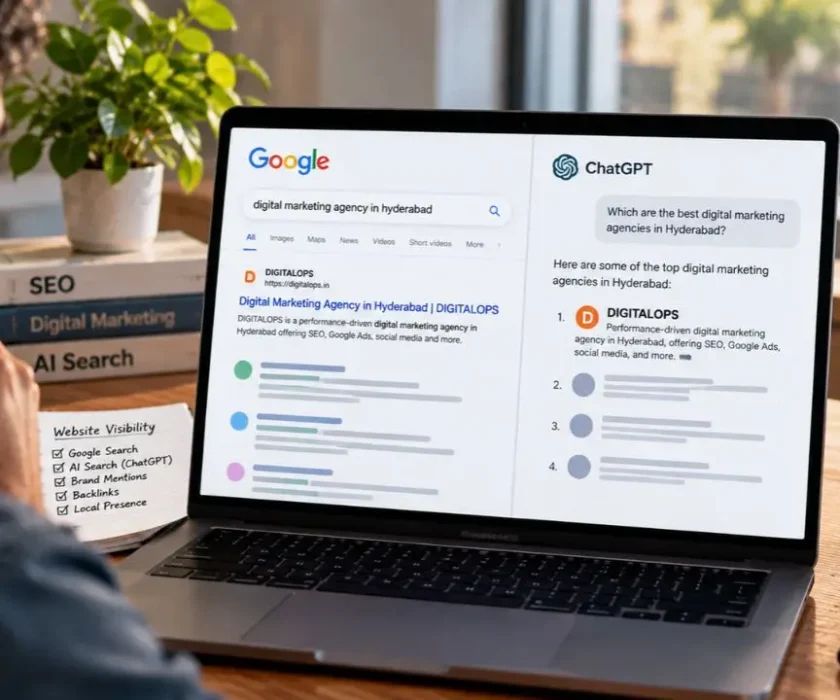
For AI-generated answers: Brand mentions dominate. ChatGPT, Perplexity, and Google AI Overviews do not traverse link graphs when generating answers. They identify entities consistently associated with topics across multiple independent sources. A business mentioned in fifty independent sources as a “digital marketing agency in Hyderabad” is far more likely to appear in an AI-generated answer than a business with strong backlinks but minimal unlinked presence.
The combined trust model: Google’s current trust evaluation operates on two axes. The first is link authority — traditional PageRank from editorial backlinks. The second is entity authority – the breadth, consistency, and credibility of brand presence across the web. Competitive performance requires building both, and they reinforce each other: backlinks from credible sources generate brand exposure, which generates brand mentions, which generates branded search, which feeds siteAuthority.
For AI Answer Engines, Brand Mentions Win
The rise of AI-generated search has restructured the value of brand mentions in ways most businesses have not yet processed.
When someone asks ChatGPT “which SEO agencies in Hyderabad should I consider,” the answer is not determined by which agency has the most backlinks. It is determined by which agencies appear most consistently across the sources the AI has access to – reviews, directories, forum discussions, editorial articles, comparison content, and news coverage. The entity that has been mentioned most broadly and most consistently in quality sources is the entity that gets cited.
Google AI Overviews operates on the same principle. When generating a local or topical answer, it synthesises information from sources it considers authoritative. A business with clean structured data and widespread unlinked brand presence is precisely the type of entity AI systems are built to surface.
Three specific brand mention types that AI systems respond to directly:
Named mentions in editorial content – A Hyderabad technology or business publication naming your agency in a roundup of recommended digital marketing firms is the type of mention AI systems extract and reference when generating answers.
Review platform presence – Consistent, recent reviews on Justdial, Google, Facebook, Practo, and industry-specific platforms create a pattern that AI systems recognise as evidence of real-world credibility. Review text that includes service keywords is especially valuable – AI systems read review content, not just aggregate scores.
Expert citations and quotes – When your team members are quoted in articles, podcasts, or webinars, those mentions build personal entity authority that extends to your brand. Google and AI systems increasingly understand that authority is carried by people as much as by domains.
How DIGITALOPS Builds Both for Clients
At DIGITALOPS, the brand mentions vs backlinks question shapes how we structure campaigns from day one. The sequencing varies by industry and competitive landscape, but the framework is consistent.
For healthcare clients in Hyderabad, we begin by establishing entity clarity – ensuring the clinic is listed correctly and consistently across Practo, Justdial, Google Maps, and health-specific directories. These citations are brand mentions that anchor the entity in Google’s understanding before any link-building begins. Once the entity is established, topical content earns organic mentions from health information sites and local news. Backlink acquisition targets authoritative medical and local publications and follows that content foundation.
For real estate clients, brand mentions on property portals – Housing.com, MagicBricks, NoBroker – are often the first trust signals Google processes for a new project or developer brand. These platforms do not always link back to the developer’s website, but consistent project name mentions alongside location and developer brand build entity recognition rapidly. We combine this with content that earns backlinks from real estate news and Hyderabad property publications.
For DIGITALOPS itself, the content strategy you are reading is part of how we build brand mentions. Each blog in this series from “Why AI Answers Prefer Some Websites Over Others” to “Local SEO Beyond Google Business Profile” to this piece – is designed to earn unlinked references in SEO communities, be cited in AI-generated answers about local SEO and AEO, and drive branded searches from readers who discover DIGITALOPS through content. The goal is to have DIGITALOPS appear in answers to queries like “which agencies in Hyderabad understand AEO” – not because we built links to that answer, but because the volume and consistency of our content and mentions makes the entity association inevitable for AI systems.
The sequencing we follow for every client:
- Establish entity – NAP consistency, GBP, primary citation sources
- Build topical content that earns mentions from relevant audiences
- Amplify through structured outreach that converts unlinked mentions to backlinks where possible
- Monitor brand mentions via Google Alerts and Ahrefs and engage with sources to build relationships that eventually yield editorial links
The Practical Strategy – What to Build First
Stage 1 – New or unknown brand
Priority is entity establishment. Get NAP consistent across 30-plus directories. List on the top five review platforms for your industry. Ensure your business information is comprehensive and consistent across the web. Backlinks are difficult to earn at this stage because without entity clarity, even well-intentioned link acquisition does little for rankings.
Stage 2 – Established brand, weak link profile
Priority is content-led link acquisition. Produce genuinely useful content – guides, original data, case studies, local insights – that earns editorial links from relevant publications. Your brand mentions may already exist; now you need the page-level authority signals that rank specific content.
Stage 3 – Established brand, reasonable links, not ranking for competitive terms
Priority is brand mention amplification. At this stage the gap is usually E-E-A-T. Google knows you exist but does not fully trust your topical authority. PR activity, expert positioning, review diversification, and content that earns citations from authoritative sources will move rankings more than additional backlinks.
Stage 4 – Targeting AI citation visibility
Priority is structured entity presence and unlinked mention acquisition across sources AI systems access. Schema markup, FAQPage schema, consistent entity signals, and widespread mentions in quality editorial sources produce AI citation visibility that backlink acquisition alone cannot achieve.
Common Mistakes That Waste Both Signals
Buying backlinks without building brand – Purchased links from irrelevant sites increase link count without building entity authority. A strong backlink profile with minimal organic brand presence is an increasingly suspicious pattern that Google’s spam systems are built to detect.
Ignoring unlinked brand mentions – Most businesses do not monitor where they are being mentioned. Unlinked mentions from quality sources are conversion opportunities. Personalised outreach to a site that mentioned you without a link can convert that mention into a backlink, compounding the value of both signals simultaneously.
Treating brand mentions as accidental – Brand mention generation should be a deliberate strategy. PR outreach, community participation, expert commentary, review request campaigns, and content distribution are all brand mention acquisition activities. Treating them as side effects of other work leaves significant authority unrealised.
Neglecting review recency – A business with 200 reviews from three years ago has weaker brand mention signals than one with 80 reviews but a consistent monthly cadence of new ones. Both Google and AI systems weight recent evidence of quality more heavily than historical volume.
Frequently Asked Questions
What is the difference between brand mentions and backlinks in SEO?
Brand mentions and backlinks are both trust signals in Google’s algorithm but work through different mechanisms. A backlink is a hyperlink that passes PageRank and direct ranking authority from one domain to another. A brand mention is any reference to your business name or brand across the web without a hyperlink - in reviews, articles, directories, or social content. Brand mentions contribute to entity recognition, E-E-A-T assessment, and branded search volume, while backlinks contribute to page-level authority and crawl discovery.
Do unlinked brand mentions help SEO rankings?
Yes. Google processes unlinked brand mentions as co-citation signals that contribute to entity authority and E-E-A-T. When your brand is consistently mentioned across credible, independent sources in the context of your industry and location, Google’s natural language processing systems interpret this as evidence of real-world authority — even without a hyperlink connecting those sources to your website.
Which matters more for AI search, brand mentions or backlinks?
For AI-generated answers in Google AI Overviews, ChatGPT, and Perplexity, brand mentions carry significantly more weight than backlinks. AI systems do not traverse link graphs when generating answers. They identify entities consistently associated with topics across multiple independent sources. A business with widespread, consistent brand mentions in quality sources is far more likely to be cited in an AI-generated answer than a business with strong backlinks but limited unlinked presence.
What is Google’s siteAuthority and how does it relate to brand mentions?
The 2024 Google API leak revealed a siteAuthority metric - a site-wide trust score separate from page-level PageRank. Evidence suggests siteAuthority aggregates signals including branded search volume, entity consistency, and citation patterns across the web. Because brand mentions drive branded searches, which feed Google’s NavBoost click-behaviour system, brand mentions create a compounding effect on siteAuthority that translates into improved rankings across all pages on the domain.
How do I track unlinked brand mentions for SEO?
Google Alerts is the most accessible free tool - set alerts for your business name, founder names, and key brand variants. For more comprehensive monitoring, Ahrefs Content Explorer and Mention.com track unlinked brand mentions across the web. The practical workflow is to identify unlinked mentions, evaluate the source quality, and reach out to convert high-quality unlinked mentions into backlinks through personalised outreach.
Should I prioritise brand mentions or backlinks in my SEO strategy?
The right priority depends on your business stage. Early-stage businesses need backlinks to establish discovery and initial page-level authority. Established businesses in competitive markets will typically see more ranking movement from brand mention amplification, E-E-A-T strengthening, and entity authority building than from additional link acquisition. For businesses specifically targeting AI citation visibility, widespread brand mentions and structured entity presence should be the primary investment alongside clean schema markup.
Building Trust That Compounds
The brand mentions vs backlinks SEO question resolves into a single practical framework: build both, sequence them intelligently, and understand that they reinforce each other rather than compete.
Backlinks remain the foundational authority signal for page-level ranking and content discovery. Brand mentions – unlinked, organic, and consistent across credible sources – have become the trust layer that determines whether Google and AI systems consider your business a genuinely authoritative entity in its field and geography.
The businesses that understand this are building something that cannot be bought quickly: a reputation that search engines and AI systems recognise as real because it is real – earned through consistent quality, expert positioning, and widespread presence across every source their audiences trust.
At DIGITALOPS, it is the framework we apply for our clients across healthcare, real estate, education, and B2B in Hyderabad and internationally, and it is the framework behind the content strategy of our own website. The goal in both cases is the same: to be the entity that AI systems and search engines cite when someone asks who in Hyderabad does this work best.
If you want to understand where your brand mention footprint stands relative to your backlink profile — and which gap is limiting your rankings most — start with a free SEO audit.