Two years ago, AI Overviews appeared on fewer than 6% of Google searches. By Q3 2026, that number had reached 61.43%.
Understanding how AI Overviews affect SEO starts with that number. This is not a gradual shift. Google has replaced its own traditional results with AI-generated answers across the majority of queries. If your SEO strategy does not account for it, you are optimising for a version of Google that no longer exists for most searches.
DataForSEO’s Search Insider 2026 report analysed 190 million keywords, 165 million AI answers, and 1.1 billion backlinks. Here is what the data shows about organic visibility, which businesses are most exposed, and what actually drives rankings and AI citations today.
The CTR Numbers Tell the Real Story
Before getting into which queries trigger AI Overviews or which industries are most affected, the most important thing to understand is what they do to organic click-through rates.
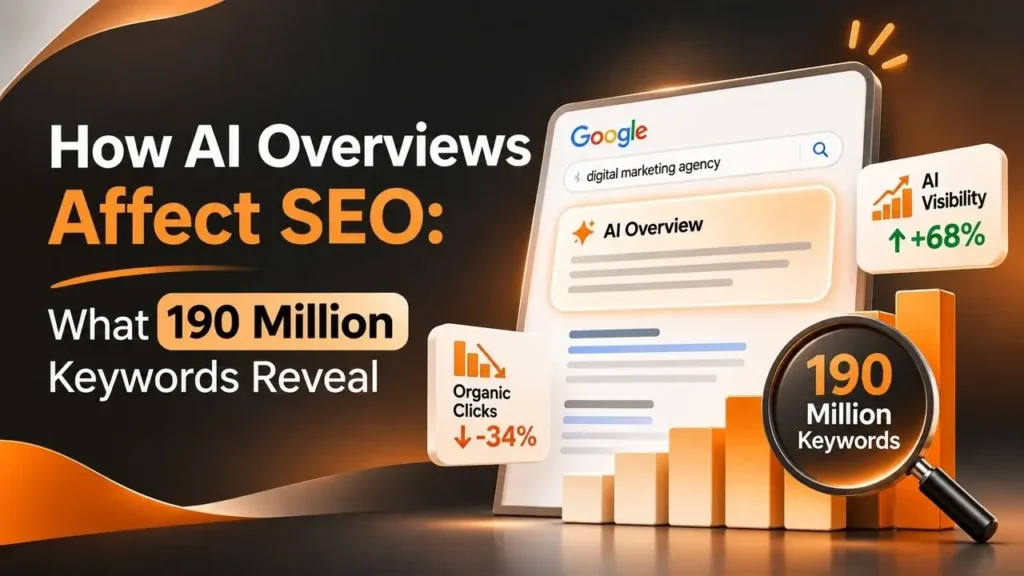
When an AI Overview appears on a search results page, it captures 42–45% of the total clicks. The organic position one result, which previously received 33–38% of clicks, drops to 21–24%.
That is a significant redistribution. A page ranking first no longer receives first-position traffic when an AI Overview is sitting above it. The clicks go up the page, not down.
The organic CTR data confirms this. Between September 2025 and August 2026, desktop CTR for the number one organic position fell by 10.41 percentage points. Position two fell by 12.20 points. Mobile saw much smaller declines, which suggests the effect is more pronounced on desktop where AI Overviews tend to take up more visible space.
The key point: rankings have not changed. Traffic from those rankings has. These are now two separate things to track.
Which Searches Trigger AI Overviews
Informational queries are the most affected — 70.44% of informational searches in Q3 2026 triggered an AI Overview. That is expected. AI systems are built for answering questions, and informational queries are questions by nature.
The commercial query data is more significant for businesses. In Q4 2025, 26.30% of commercial queries triggered an AI Overview. By Q3 2026, that rate had reached 51.35%. That is a near-doubling in one year.
Commercial queries are searches where someone is evaluating options or preparing to buy. When more than half of those searches in the US are now surfacing an AI-generated answer before organic results, the assumption that AI Overviews are mainly a problem for blog content or educational pages is no longer valid.
The keyword difficulty data adds something else worth noting. Mid-difficulty keywords, where most businesses focus their SEO effort, trigger AI Overviews around 65% of the time. That is actually a higher rate than the most competitive keywords (KD 81–100), which trigger them at 53.76%. There is no safe range in the middle.
Which Industries Are Most Exposed
Trigger rates vary considerably by industry, and some of the highest-exposure categories are ones where local and service businesses operate every day.
Health sits at 69.68%, the highest of any industry in the dataset. Finance follows at 68.80%. In both categories, users ask a lot of research and decision-making queries, and AI is now answering most of them before users scroll to organic results.
Real estate is at the other end: 22.27% AI Overview trigger rate, the lowest of the industries measured. For real estate searches — particularly local commercial queries — the organic results are largely intact. That is a meaningful difference in how the SERP operates across industries.
The practical implication is that the same SEO strategy does not apply uniformly. A healthcare or finance business competing on informational and commercial keywords faces a fundamentally different search environment than a real estate business targeting location-based queries. Industry context determines how much of your traffic exposure is at risk and what to prioritise.
What the Backlink Data Actually Shows
The report’s findings on backlinks and referring domains are worth reading carefully, because they complicate a popular argument that links no longer matter in AI search.
The data shows the opposite.
For Google AI Overviews, the correlation between referring domains and AI citations is ρ = 0.406. For ChatGPT, it is ρ = 0.377. Both are positive and statistically meaningful. Sites with more referring domains are more likely to be cited in AI-generated answers.
The relationship becomes more pronounced for harder keywords. Sites cited in AI Overviews for the most competitive queries (KD 81–100) had a median of 1,571 referring domains, compared to 282 for the easiest keywords. That is a 5.6-fold difference. For the most contested searches, the backlink profile required for AI visibility is substantial.
This does not prove that building more links will directly increase AI citations. But it does mean that domain authority is relevant not just for organic rankings but for the AI layer above them. The two are not competing priorities.
There is a nuance in the data worth flagging for businesses that have focused heavily on UGC links. The correlation for referring domains overall (0.406) is stronger than for UGC-specific backlinks (0.342). A broad, diverse backlink profile outperforms one concentrated in forum links and community mentions. Quality and breadth of referring domains matters more than raw link count or source type.
Reddit, Third-Party Platforms, and Where Your Brand Actually Appears
One finding from the report that tends to surprise people: Reddit appeared in the top 10 Google results for 32.15% of analysed searches in Q3 2026. That is roughly one in three searches surfacing a Reddit thread on page one.
Reddit is also the second-most-cited domain in both Google AI Overviews and ChatGPT in the dataset. YouTube holds the top position for AI Overview citations, while Wikipedia leads in ChatGPT.
The implication for businesses is that your competitors for visibility are not only other companies in your industry. They include Reddit discussions, YouTube videos, Wikipedia articles, and publisher sites that cover your topic. A page ranking position three and sitting below a Reddit thread at position one is competing against user-generated content for clicks, and those same platforms are shaping AI answers too.
This means brand visibility across the wider web – not just your own site’s rankings – is now a meaningful signal. If discussions on Reddit, Quora, or industry forums about your service category consistently appear in search and AI answers without mentioning your brand, that is both a gap and an opportunity. Getting mentioned in the sources that AI platforms already prefer is different work from building your own site’s rankings, but the two reinforce each other.
What This Means for Your SEO Strategy
The data does not suggest traditional SEO is obsolete. It suggests that SEO without an AI visibility layer is now incomplete.
Organic rankings still drive traffic, particularly on mobile and for queries that do not trigger AI Overviews. Building domain authority through quality backlinks and technical SEO remains a foundation. The difference is that the same effort now produces less traffic from the same ranking position than it did two years ago, as AI Overviews intercept a growing share of clicks.
The practical question for any business is where the gap is. A site can hold strong organic rankings while being completely absent from AI answers. These are measured separately and improved through different means.
For industries with high AI Overview trigger rates — healthcare, finance, B2B services — structured FAQ content, specific answer-ready writing, and clear entity signals become more important than they were when organic results absorbed the majority of clicks. For industries with lower trigger rates like real estate, local SEO fundamentals continue to perform reliably.
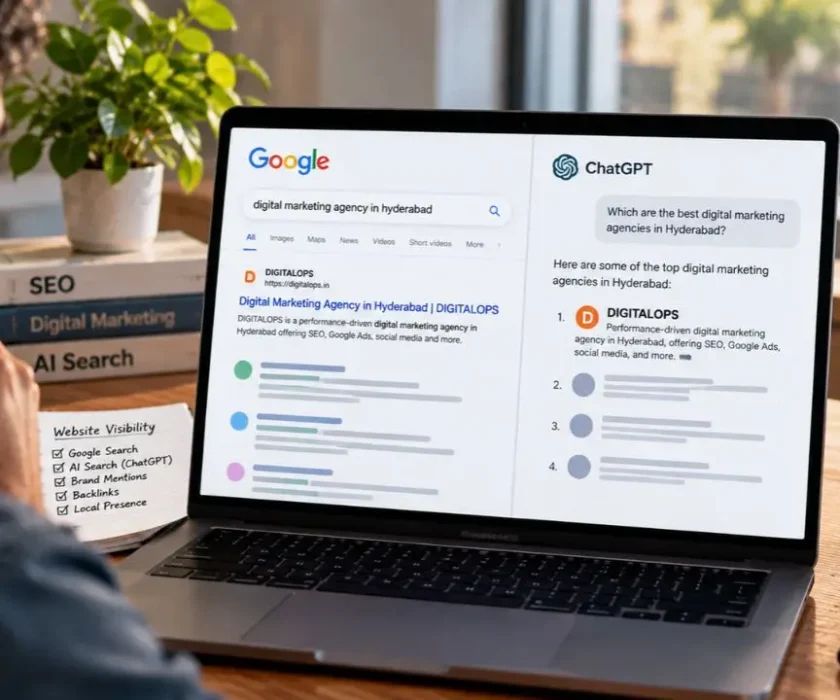
DIGITALOPS’ SEO services cover the organic foundation — rankings, technical health, and content that earns authority over time. The AI SEO services layer addresses what the data above describes: optimising for the AI search environment that now sits above organic results on the majority of queries. For businesses that need to appear in ChatGPT, Gemini, and Perplexity answers – the AI surfaces operating completely outside the traditional search funnel – answer engine optimisation covers that specifically.
If you want to understand where your business currently stands across both, the AI visibility checker runs live queries against the major AI platforms and shows how they describe your business today and who they recommend instead.
The 61% Figure Is Not a Ceiling
The DataForSEO data covers searches through Q3 2026. The AI Overview trigger rate stood at 61.43% at that point, up from 5.93% two years earlier. There is nothing in the trajectory suggesting that growth stops here.
The businesses reviewing their search strategy now — before the traffic decline becomes the reason to review it — are the ones that will adapt more cleanly. The data makes the picture measurable. The gap between organic rankings and AI visibility is real, it is growing, and it is closeable with the right approach.
Source: DataForSEO Search Insider 2026
Frequently Asked Questions
Do AI Overviews hurt SEO rankings?
AI Overviews do not directly change where a page ranks in organic results. What they change is how many clicks that ranking receives. When an AI Overview appears, it captures 42–45% of clicks on the page, reducing the share reaching positions one and two. Rankings and traffic from those rankings are now two distinct metrics to track separately.
Which searches are most affected by AI Overviews?
Informational queries have the highest trigger rate at 70.44%. More significant for businesses is the commercial query rate, which nearly doubled from 26.30% to 51.35% in one year. Health (69.68%) and finance (68.80%) are the most affected industries. Real estate has the lowest rate among major industries at 22.27%.
Do backlinks still matter when AI Overviews are present?
Yes. DataForSEO’s data shows a positive correlation between referring domains and AI citations in both Google AI Overviews (ρ = 0.406) and ChatGPT (ρ = 0.377). Sites cited for more competitive queries tend to have substantially larger backlink profiles. Building domain authority through quality links supports both organic rankings and AI visibility.
What is the difference between SEO and AI SEO?
Traditional SEO optimises for organic search rankings — how a page performs in Google’s standard results. AI SEO extends that to the AI-generated answer layer: how AI Overviews, ChatGPT, Gemini, and Perplexity represent and recommend your business when users ask relevant questions. The two require overlapping but distinct signals. Strong organic rankings support AI visibility but do not guarantee it.
What is answer engine optimisation and why does it matter?
Answer engine optimisation (AEO) is the practice of making a business’s content and entity presence visible in AI-generated answers, the responses that ChatGPT, Gemini, and Perplexity give when users ask questions. As more search behaviour shifts to these platforms, appearing in AI answers becomes a separate acquisition channel from organic search. AEO is not an extension of SEO; it uses overlapping signals but requires distinct content structure, schema markup, and entity-building work that most traditional SEO campaigns do not cover.
Should I still invest in SEO blog content if AI Overviews are taking clicks?
Yes, but the purpose has shifted. The goal of a blog post in 2026 is not only to rank and collect clicks. It is to build topical authority that improves overall site visibility, to earn the referring domain signals that AI systems use for citation decisions, and to create content specific enough to appear directly inside an AI Overview. A blog that answers a specific question clearly can appear within an AI answer even while that answer reduces clicks to the page. The two effects are not mutually exclusive.
How can I check whether my business appears in AI search results?
You can test manually by asking ChatGPT or Perplexity relevant questions about your industry and location and checking whether your business is named. For a structured check across multiple platforms and query types, the AI visibility checker runs the queries automatically and returns a clear read on how your business currently appears and what is stopping AI from recommending you.